Key data needed to independently assess Hyundai’s financial exposure under the EU’s CBAM remains unavailable to investors.
July 16, 2026 (SEOUL) – Hyundai Motor Group’s disclosure of an estimated Carbon Border Adjustment Mechanism (CBAM)-related cost of approximately $1.4 million by 2030 may understate its potential exposure. However, under the modeling of this new analysis, the costs of CBAM compliance could range from $59.5 million to $99.2 million by the same year. Should Hyundai continue without providing verified emissions data, the estimate would be pushed to as high as $129 million.
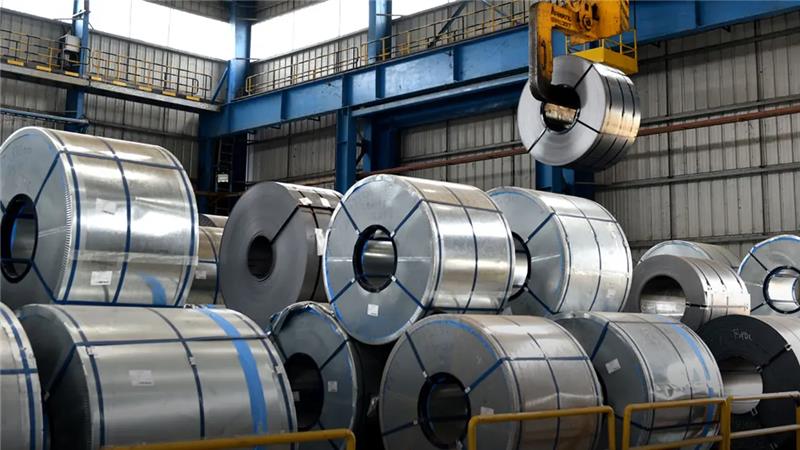
The EU’s CBAM entered its definitive phase in January 2026, already making steel carbon costs take effect for the Czech and Slovak plants of Hyundai Motor Group (HMG). In February 2026, Hyundai Steel briefed 160 representatives from 30 European client companies on CBAM scenarios, yet equivalent information has not been made available to HMG’s own investors. Without underlying data inputs—carbon intensity, steel origin, procurement method, and calculation methodology—investors cannot independently verify or price HMG's CBAM exposure.
The analysis finds that Hyundai's disclosed figure appears more consistent with 2026 transitional parameters than a 2030 projection, by which point the phase-in factor will have risen from 2.5% to 48.5%. The modeled figures are approximately 42 to 70 times higher than HMG’s disclosed estimate, with this difference reflecting missing underlying disclosure rather than uncertainty in the regulatory framework. Kia, whose Slovak plant faces a larger modeled exposure, has disclosed no figure at all.
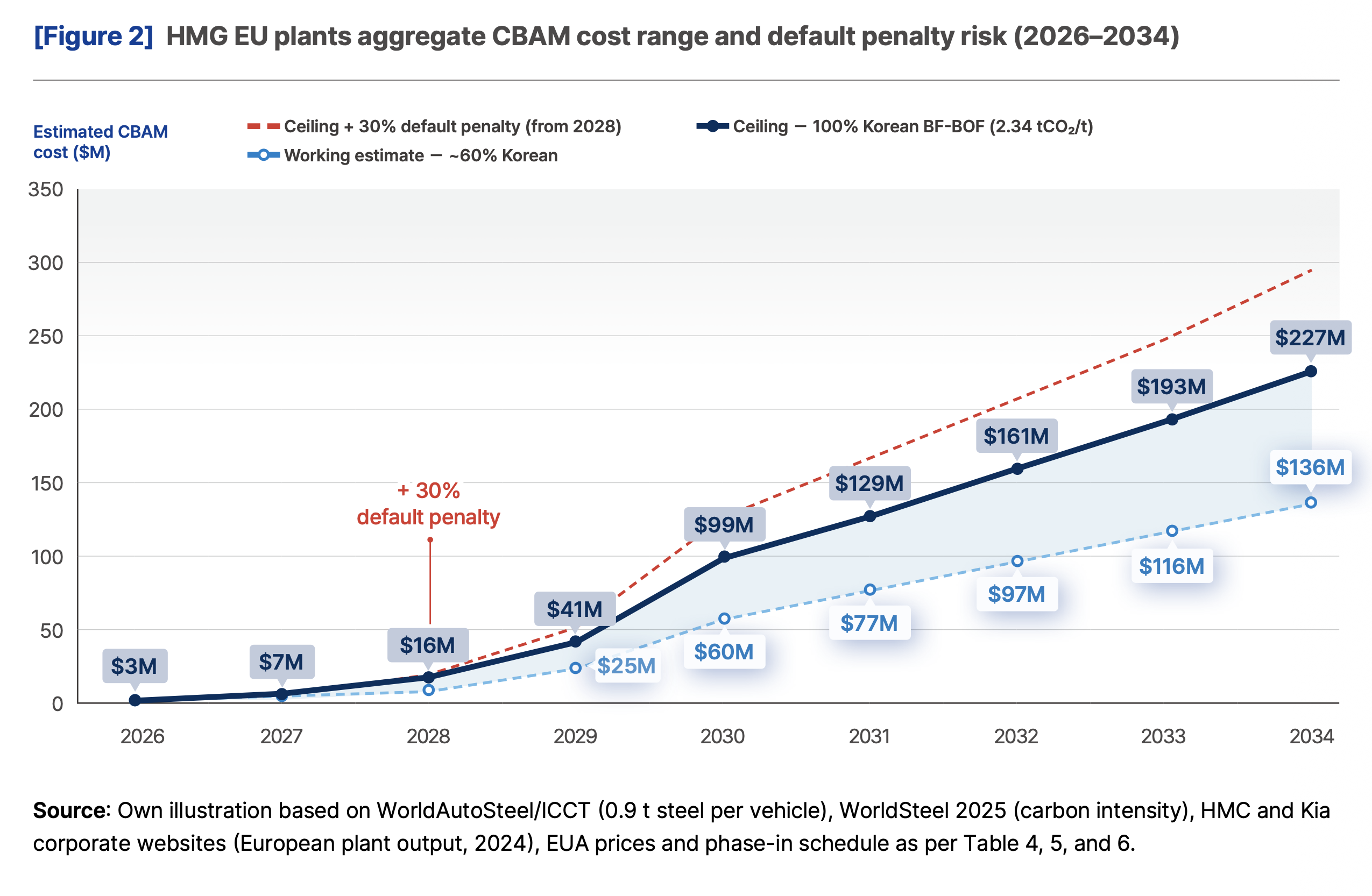
The finding holds across calculation methods and assumptions. Recalculated using the European Commission’s own published default values for Korean steel, the 2030 liability remains over 60 times the disclosed figure. Under CBAM’s definitive phase certificate calculation, it rises further up to 100 times. The report’s range uses a more conservative carbon intensity assumption than the EC’s defaults, meaning that for steel mixes classified as high-strength alloy grades under the EU law, the exposure is higher still.
From 2028, the EU has proposed extending CBAM to 180 downstream products including automotive components and commercial vehicles, while importers without verified data already face a markup on default values—10% today, rising to 30% from 2028. As the scope widens, investors will need more complete disclosures to accurately assess Hyundai’s potential CBAM exposure.
The report identifies three concrete areas investors should ask: (1) disclosure of the carbon footprint of steel used in HMG's EU plants, (2) a transparent methodology behind the $1.4 million cost estimate, and (3) clarity on where HMG's steel comes from and how it is produced. The report also provides the full technical disclosure list and financial model for investors who need to price this exposure independently.
The data needed to close the gap already exists, and Hyundai Steel has shared this information with commercial partners in Europe earlier this year. Disclosing verified emissions data to investors carries no cost, while immediately removing the default-value penalty. As CBAM obligations grow and the 2028 deadline approaches, the case for sharing it with investors only becomes stronger.
Stefanie Spescha, Climate Finance Strategist, Investor Engagement, at Solutions for Our Climate (SFOC), said, "This report is not about claiming to determine Hyundai Motor Group's exact steel-related CBAM costs. It is about showing that investors cannot independently verify the company's disclosure or assess its potential financial exposure using the information currently available. When financially material assumptions remain undisclosed, markets cannot evaluate that exposure with confidence. The unquantified is not unquantifiable—it is simply undisclosed."
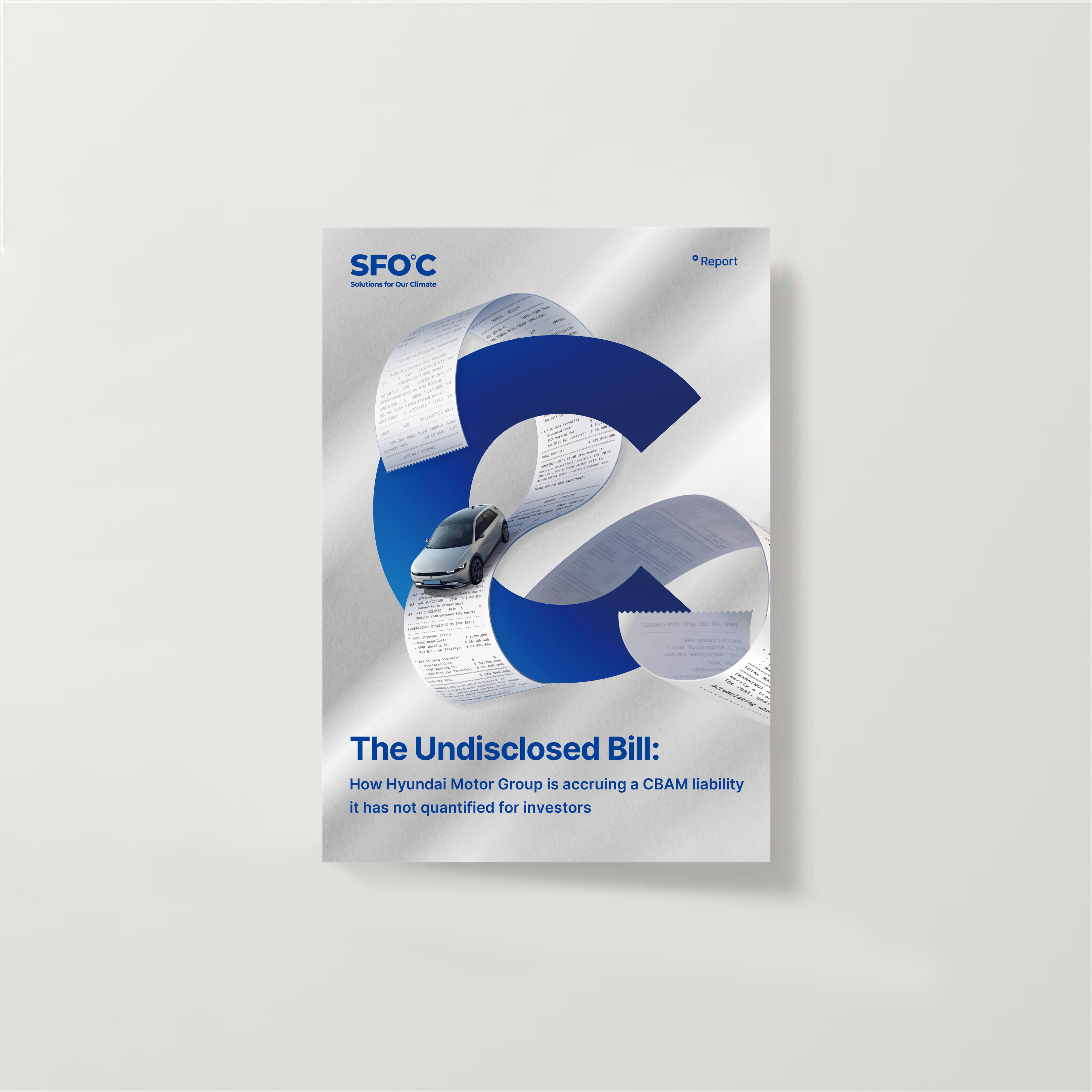
The full report is available here: The Undisclosed Bill: How Hyundai Motor Group is accruing a CBAM liability it has not quantified for investors
ENDS.
Solutions for Our Climate (SFOC) is an independent nonprofit organization that works to accelerate global greenhouse gas emissions reduction and energy transition. SFOC leverages research, litigation, community organizing, and strategic communications to deliver practical climate solutions and build movements for change.
For media inquiries, please reach out to:
Frances Danielle Monsada, International Communications Officer, francesdanielle.monsada@forourclimate.org
Share this insights






![[Brief] South Korea’s international public finance continues to block a just energy transition](https://content.sfoc.tapahalab.com/images/research/RC5Kime.jpg)


![[Report] The Inconsistent 'Coal-Free Pledge' of Korea's National Pension Service](https://content.sfoc.tapahalab.com/images/research/VcDPdme.jpg)

![[CREA-SFOC] Unveiling the Truth Behind Blast Furnace Pollution_South Korea](https://content.sfoc.tapahalab.com/images/research/C4Xvdme.jpg)


![[Issue Brief] Assessment of Climate Change Policies of Major South Korean Financial Institutions](https://content.sfoc.tapahalab.com/images/research/a4ondme.jpg)


![[토론회] 한국형 녹색분류체계(K-Taxonomy), 무엇이 녹색경제활동인가](https://content.sfoc.tapahalab.com/images/research/bn8jdme.jpg)


