In our last blog, we explored why green steel standards matter and what makes them credible. Here, we will take an in-depth look into the more and less credible methodologies for green steel standards emerging in East Asia, one of the world’s leading steel-producing regions. To help navigate these approaches, SFOC has assigned green, yellow, and red light ratings to reflect how effective each methodology is in driving real emissions reductions, and how transparent and resistant to greenwashing it is.
Japan Derailed: Mass Balance-Based Allocated CFP Methodology
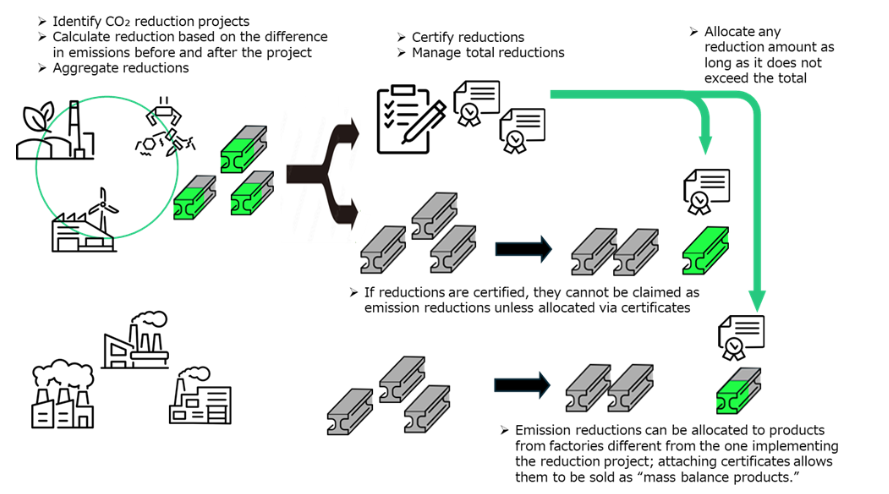
Japan is currently implementing a standard under its national Green Transformation (GX) framework, which is based on allocated carbon footprint (CFP) methodology which uses a mass balance carbon accounting method. Under this methodology, emission reductions achieved from multiple mitigation projects can be pooled and allocated across a company’s total steel output, allowing products to receive a low-carbon label, even where the physical link between those reductions and the labeled product is unclear or unproven.
Red Light 🔴(mass balance without physical traceability): Because emissions reductions are calculated and assigned at an aggregated level, the “green” label does not reflect how a particular steel product was made. This weakens product‑level transparency and increases the risk of greenwashing.
On Track, China: Performance-Based Methodology
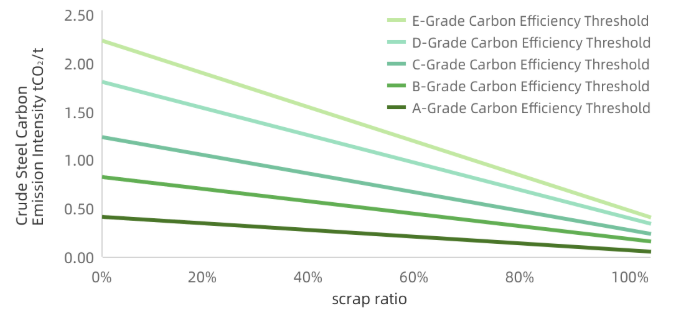
China, the largest steel producer, has taken a different methodology. The China Iron and Steel Association (CISA) has introduced the China to Future (C2F) steel standard to classify steel based on carbon emission intensity and the ratio of scrap input, using a performance-based sliding scale. This methodology allows different production routes to be assessed on a comparable basis while maintaining clear incentives for emission reductions in primary steelmaking process. The sliding scale is aligned with the International Energy Agency’s (IEA) definitions of near-zero and low-emissions steel and does not permit pooling emissions reductions across steel products.
The C2F standard has also become part of broader international interoperability efforts. ResponsibleSteel has signed separate Memoranda of Understanding (MoU) with both the C2F standard and the Low Emissions Steel Standard (LESS).
As two of the world’s leading green steel standards, both ResponsibleSteel’s International Production Standard and LESS similarly align with the IEA’s near-zero and low-emission steel definitions and require clear, product-level emissions, explicitly excluding mass balance approach.
Together, C2F standard, ResponsibleSteel’s International Production Standard, and LESS now collectively cover around 60% of global steel production, signaling growing alignment across major steel-producing regions.
Green Light 🟢 (clear and credible carbon intensity thresholds): A sliding scale based on carbon intensity and scrap share avoids a one-size-fits-all cutoff, so different production routes can be compared fairly without lowering the bar for “green”.
Green Light 🟢 (international interoperability): Signing a MoU with ResponsibleSteel which has already developed a comprehensive framework for credible interoperability covering GHG accounting rules metric conversion methods, assurance mechanisms and the use of claims and labels, is a practical step toward consistent recognition across borders.
Where To Go, South Korea: Emerging Allocated CFP Methodology
In South Korea, the design of a national green steel standard remains under development, and no official methodology has yet been finalized. However, a recent industry discussion led by the Korea Iron and Steel Association (KOSA) during the 30th Conference of the Parties (COP30) explored the use of allocated CFP methodology as one possible option. In parallel, a recent report by the POSCO Research Institute (POSRI) also supported the allocated CFP methodology as a practical mechanism, while ensuring consistency with the Paris Agreement, including preventing double counting.
Yellow Light 🟡 The same greenwashing risk. If South Korea adopts an allocated CFP system without strong requirements to link emissions data to specific steel products, there is a similar risk that “green steel” labels could mask significant differences in how steel is actually produced.
Why These Differences Matter?
These cases show how green steel standards are being differently designed across East Asia’s major steel-producing countries, accounting for over 60% of global steel production. At this scale, whether these standards can be internationally interoperable will have direct consequences for procurement decisions, cross-border recognition, and trade outcomes. Design choices around accounting methods, thresholds, and traceability therefore matter not only domestically but also internationally.
Credible and interoperable standards are essential, not only for a well-functioning global steel market, but for delivering genuine steel decarbonization and enabling the broader green transition. Getting this right will be critical for the steel sector’s role in the global green transition.
Edited on July 20, 2026
Related insights
Advancing the Transition Away from Fossil Fuels
Key Outcomes from Santa Marta
2026-05-29
Is 'Green Steel' Actually Green? Why Standards Matter
Green Steel Standards Blog Series #1
2026-04-30

Hyundai Has a Chance to Lead Asia’s Auto Transition — But Time Is Running Out
Time is running out for Hyundai to match Its EV success with climate transparency
2025-09-23


