Board meets only 2 of 6 global climate governance indicators, new analysis finds
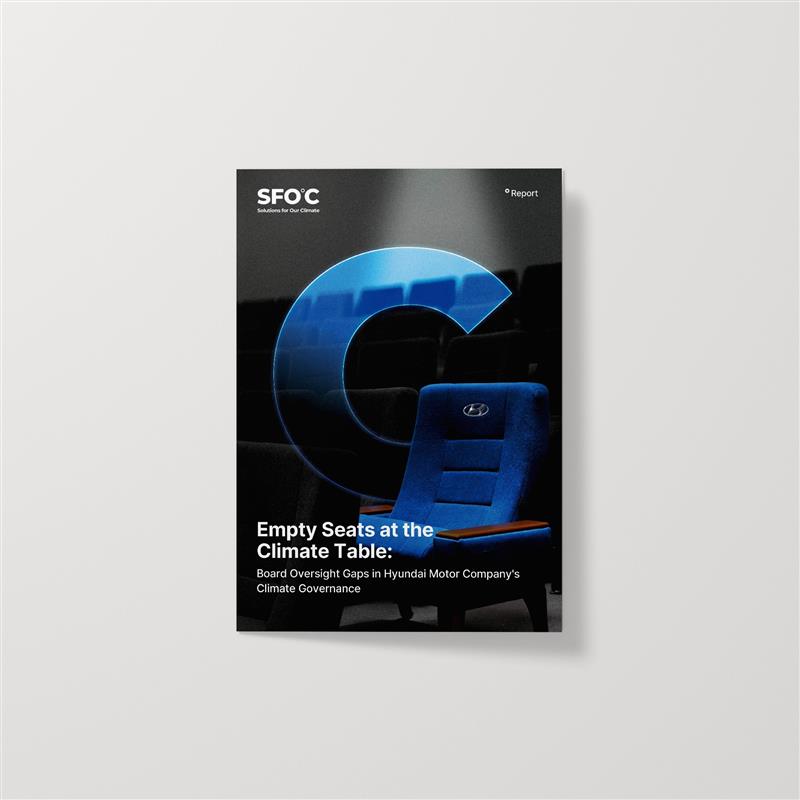
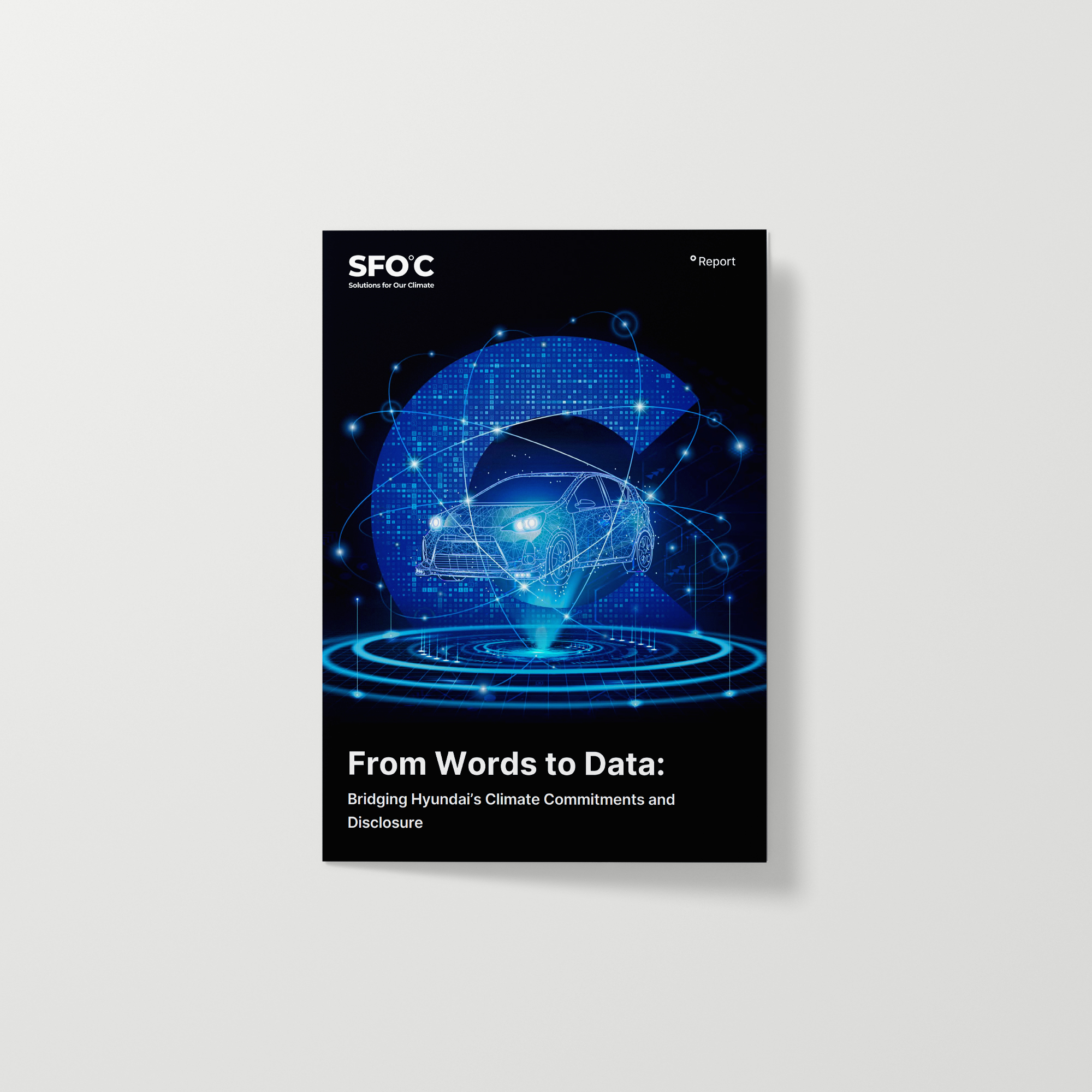
March 3, 2026 (SEOUL) – With South Korea advancing a series of revisions to the Commercial Act, including a third amendment passed on February 25, corporate governance reform continues to draw heightened attention from policymakers and global investors. Against this backdrop, a new report by Solutions for Our Climate (SFOC) titled “Empty Seats at the Climate Table: Board Oversight Gaps in Hyundai Motor Company's Climate Governance” examines whether climate-related transition risk is receiving sufficient board-level oversight at Hyundai Motor Company.
The analysis finds that Hyundai meets only two of six climate governance indicators used by Climate Action 100+, the investor-led initiative assessing corporate preparedness for the low-carbon transition. The assessment focuses on board accountability, oversight mechanisms, and integration of climate considerations into corporate strategy.
Hyundai Motor has pledged to achieve carbon neutrality by 2045, with electrification and hydrogen technologies positioned at the center of its long-term growth strategy. However, the report highlights a potential structural tension within its supply chain: key affiliate Hyundai Steel has set a 2050 carbon neutrality target. Given steel’s central role in vehicle manufacturing and its contribution to Scope 3 emissions, differences in decarbonization timelines could create longer-term strategic and cost alignment challenges.
The report does not characterize the timeline gap as an immediate operational risk. Instead, it frames it as a governance issue requiring clearer board-level visibility and coordination, particularly as regulatory and market pressures accelerate.
Based on last year’s Korean Commercial Act amendment, listed companies must maintain at least one-third independent directors. Hyundai Motor already exceeds this threshold, with independent directors comprising more than half of its board. However, the report argues that formal independence ratios alone do not necessarily demonstrate climate-specific expertise or systematic oversight of transition risk.
“Hyundai Motor does not need another formal governance mechanism,” said Hyunjeong Bak, Investor Engagement Lead at SFOC. “The company already has a Sustainability Management Committee composed primarily of independent directors. At the group level, there are also dedicated coordination bodies — including the HMG Carbon Neutrality Committee and the HMG Carbon Neutrality Council — chaired by the Hyundai Motor Group Executive Chair and involving the CEOs of major affiliates.”
“What is needed now is qualitative improvement. At the board level, Hyundai Motor should strengthen climate expertise and enhance the effectiveness of its oversight. At the group level, it needs to clearly demonstrate that emissions reduction strategies across affiliates are not only announced, but meaningfully aligned and coordinated in practice,” Bak said.
According to the findings, no independent director with clearly identified climate or transition experience was confirmed through public disclosures. The report also states that available filings provide limited evidence that climate strategy and transition risk are consistently treated as recurring standalone agenda items at the board or sustainability committee level.
For global investors, climate governance is increasingly viewed not as a branding issue but as a core capital allocation and risk management question. Hyundai faces significant transition exposure, including large-scale electric vehicle investment, evolving battery supply chains, and tightening trade-linked climate regulation.
In particular, the European Union’s Carbon Border Adjustment Mechanism (CBAM) is expected to expand in scope over time. As supply-chain emissions become more closely linked to trade costs and competitiveness, alignment between automakers and upstream materials producers may take on greater financial significance.
The report situates Hyundai’s governance questions within the context of large Korean conglomerates, where complex affiliate structures and cross-shareholding relationships can make strategic alignment across subsidiaries especially consequential. In such systems, coordination of transition timelines and capital allocation decisions may require clear and consistent board-level oversight, particularly when affiliates face differing emissions profiles and regulatory exposures.
As Korean corporates seek to attract global capital amid governance reform efforts, the report suggests that credible and clearly articulated board oversight of transition risk may serve as an important signal to international investors evaluating long-term competitiveness and valuation.
ENDS.
Solutions for Our Climate (SFOC) is an independent nonprofit organization that works to accelerate global greenhouse gas emissions reduction and energy transition. SFOC leverages research, litigation, community organizing, and strategic communications to deliver practical climate solutions and build movements for change.
For media inquiries, please reach out to Yi Hyun Kim, Communications Officer, yihyun.kim@forourclimate.org.
Share this insights







![[CREA-SFOC] Unveiling the Truth Behind Blast Furnace Pollution_South Korea](https://content.sfoc.tapahalab.com/images/research/C4Xvdme.jpg)


![[Issue Brief] Assessment of Climate Change Policies of Major South Korean Financial Institutions](https://content.sfoc.tapahalab.com/images/research/a4ondme.jpg)


![[토론회] 한국형 녹색분류체계(K-Taxonomy), 무엇이 녹색경제활동인가](https://content.sfoc.tapahalab.com/images/research/bn8jdme.jpg)


