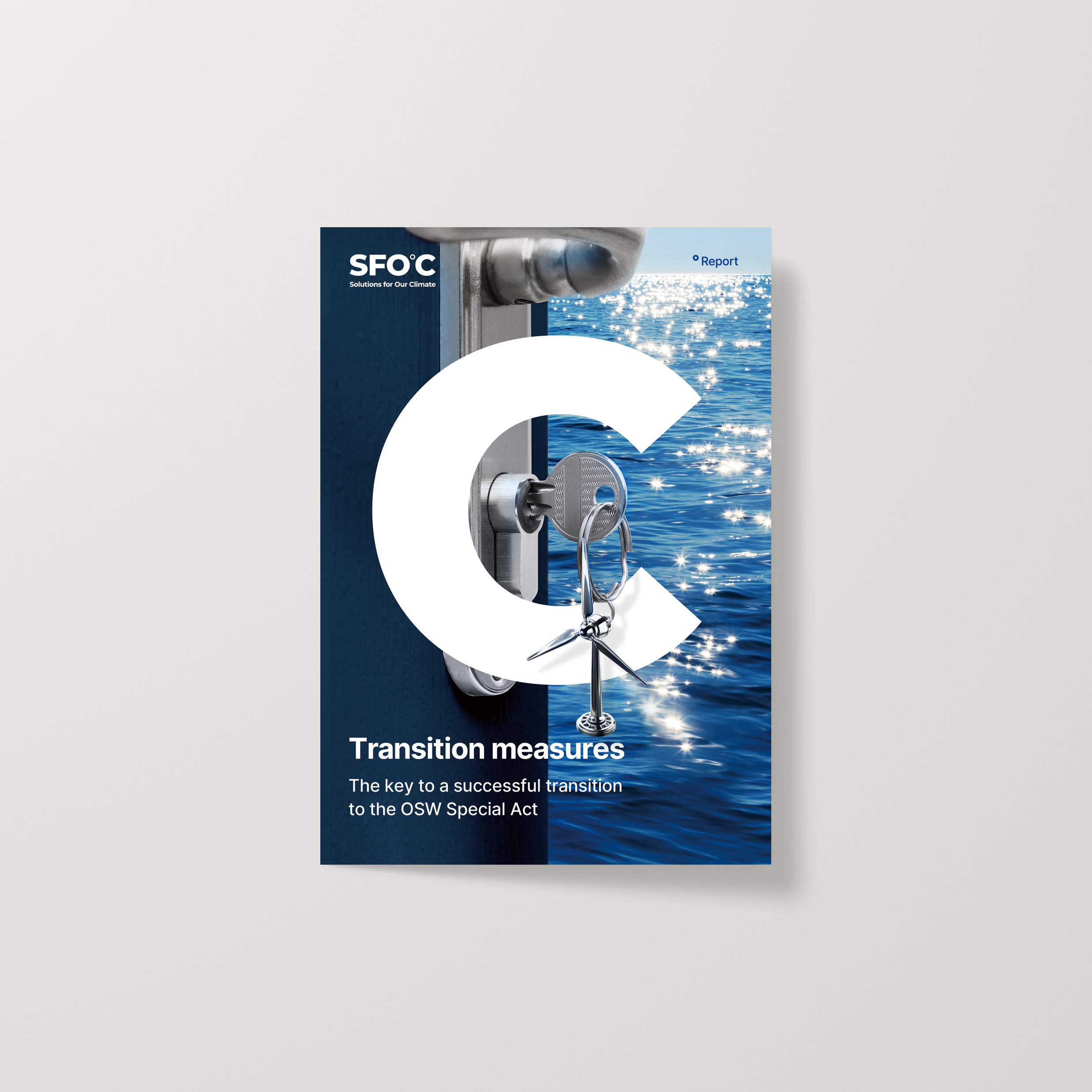
Transition measures: the key to a successful transition to the OSW Special Act

About
This paper examines the Special Act on the Promotion of Offshore Wind Power and Industrial Development (the “OSW Special Act”) and proposes transition measures to integrate existing offshore wind development businesses and energy clusters into the new regime. The analysis draws on relevant legislation, interviews with subject matter experts, and international case studies – most notably Ireland’s Maritime Area Planning Act (the “MAP Act”).
Main takeaways:
To advance the OSW Special Act’s purpose and credibility, transition measures for legacy projects should reflect the statutory qualifications for designating OSW zones and OSW developers under the new regime.
To avoid duplication and inefficiency, transition measures should leverage prior evaluations and documentation from the legacy regime, while confirming their continued adequacy, taking into account elapsed time and any material change.
Ireland’s MAP Act provides a clear reference point. The country’s shift from a developer-led to a government-led model reduced confusion by specifying in statute who qualified for transition and what criteria apply, and by establishing a phased pathway to leverage both existing and new projects toward the 2030 target.
Executive summary
The key conclusions are as follows.
First, decisions on whether to incorporate existing projects into the Special Act on the Promotion of Offshore Wind Power and Industrial Development should be made based on a substantive assessment of whether such projects meet the requirements for designation as offshore wind development zones and for the selection of project developers under the Act. This is a fundamental principle to ensure policy credibility while preserving the legislative intent of the Special Act.
Second, in order to reduce inefficient duplication of procedures, it is necessary to allow the use of previously submitted documents and past review results, taking into account factors such as the time elapsed since permitting. However, such flexibility should not be interpreted as exempting projects from a substantive evaluation of whether they meet the relevant requirements.
Third, a representative international reference for designing transitional arrangements is Ireland’s Maritime Area Planning Act (MAP Act). Similar to Korea, Ireland transitioned from a system with pre-existing projects to a government-led, plan-based site designation regime. In doing so, it minimized uncertainty during the transition by clearly defining eligible projects and evaluation criteria in legislation. In addition, Ireland established an implementation strategy that phases in both existing and new projects to achieve its 2030 offshore wind deployment targets.
Finally, transitional arrangements must be designed and implemented in a way that simultaneously considers two objectives: achieving offshore wind deployment targets and ensuring the credibility of the legal framework. If the system is not effectively implemented after its establishment, the extensive efforts—spanning more than 1,400 days—to build the legal foundation of the Special Act may not yield meaningful results. The new government should therefore promptly demonstrate tangible outcomes by showcasing both successful integration of existing projects and new project development under the Special Act, thereby translating institutional reform into real-world progress.
Related research
Choosing a Green Steel Pathway : Implications for South Korea, Japan, and Australia
2026-09-14
Solving the Renewable Energy Disconnect: Enabling Korea’s 100GW RE Target Through Priority Grid Connection Policy
2026-06-01
Unlocking Agrivoltaics: Extending the Temporary Non-Agricultural Use Permission Period for Farmland
2026-05-14
Financing Strategies for Coal Phase-Out: Germany's Sovereign Green Bond Model and Implications for South Korea
2026-04-21
Recurring Crisis, Delayed Transition: From Fossil Fuel Dependence to Energy Independence
2026-03-18
Reforming South Korea's Power Sector: Setting the Stage For the Renewable Energy Transition
2026-02-04
Why LNG Reduction Matters: Redefining Energy Security and Unlocking Economic Gains
2025-12-08
Establishing Offshore Wind Dedicated Taskforce Within Defense Departments : Global Case Studies
2025-12-02
Settled in Secret: The Opaque Grid Fee System Undermining Renewable Energy PPA Expansion in South Korea
2025-12-01
South Korea’s Export Credit Finance in Transition: National Economic Impacts of the Global Shift from Fossil Fuels to Clean Energy
2025-11-16
VPPs: The Key to Korea's Transition to a Renewable Energy-Based Power System
2025-08-28
Accelerating Renewable PPAs in South Korea: 2025 Regulatory Updates and Unresolved Challenges
2025-08-06
Speed Bumps on the Renewable Energy Highway: Minimum Generation Levels of Thermal Power Plants
2025-08-05

Driving Hydrogen-Based Steelmaking in South Korea: Focus on Hydrogen Sourcing
2025-06-25

Can the Korean Semiconductor Industry Meet its Renewable Energy Targets? Policy Recommendations
2025-06-24

Analyzing Korea’s 2035 NDC GHG Emissions Reduction Pathway through an Integrated Assessment Model
2025-04-23

Against the Current I: Public Waters Occupancy or Use Permit Processing Delays and Policy Recommendations
2025-02-18

Stronger Together: Unlocking Community Power for Lasting Change
2025-02-04

South Korea's PPA System: Status and Opportunities for Renewable Energy Development
2024-10-10

Height Constraints in Offshore Wind: Current State and Challenges of the 500-Foot Limit in South Korea
2024-06-27

Renewable Energy Target Group Segmentation Survey Report in Korea
2024-05-14

12 Key Issues That Will Define Offshore Wind's Success in Korea
2023-12-04

Offshore Wind Colloquium Brief No.1 - UK case of Fisheries Engagement
2023-07-13

해상풍력 전력계통 연계 개선을 위한 세미나
2023-04-17

Up in the Air: Limitations of Korea's Offshore Permitting Process and Policy Recommendations
2023-02-13

재생에너지 출력제한 세미나
2022-09-27

2022 재생에너지 확대를 위한 정책 제안서
2022-01-26

Overseas Cases of Improvements to the Legal System for the Expansion of Renewable Energy
2021-11-30

풍력보급 활성화를 위한 RPS 제도개선 간담회
2021-09-13

Breezing Past Wind: How Korea's RPS is Sidelining the Wind Energy Market
2021-09-13

Employment opportunities from a coal-to-renewables transition in South Korea
2021-07-28


