About
This report examines the untransparent grid use fee system in South Korea, a system which has deㅅerred many companies from signing Power Purchase Agreements (PPAs) with renewable energy generators. Grid use fees, an unavoidable cost required for using the electricity grid, can add significant costs to total price of a PPA; and with the secrecy surrounding how grid fee rates are set, companies can not predict the long-term costs of ther 20-year PPA. This is a significant risk for companies, particularly in the context of previous acts of discriminatory pricing for PPA users by the state-owned utility Korea Electric Power Corporation (KEPCO).
By contrasting South Korea's grid use regulatory system to those of two international cases - Ofgem and NESO in Great Britain, and FERC and PJM in the United States - this report reveals critical structures and policies necessary to ensure a transparent, fair, and sustainable grid use fee regulatory system - a system that encourages more PPAs and grid investments to support renewable energy expansion.
Download report
Executive summary
Power Purchase Agreements (PPA) for renewable energy are an essential tool to secure investment to build new generation and advance the energy transition. However, in South Korea PPAs are impeded by a system of rigid regulations and a blackbox of opaque power grid fee rate setting standards set by the fossil-fuel oriented utility Korea Electric Power Corporation (KEPCO). Companies in South Korea that want to support the expansion of renewable energy through PPAs have stated that this opaque grid fee setting system needs to be addressed to revitalize the PPA adoption. Combined with the lack of competition in the power sector, this highlights the importance of having transparent grid fee setting systems, as power grid fees are a significant factor in a PPAs long-term price.
The Federal Energy Regulatory Commission (FERC) and PJM Interconnection (PJM) in the United States, and the Office of Gas and Electricity Markets (Ofgem) and the National Energy System Operator (NESO) in Great Britain, are two regulatory systems well known for their transparent and pragmatic grid fee setting procedures. Ofgem also goes a step further in incorporating actions for net-zero as factors in their approval process, stimulating investments for a renewable-friendly and sustainable power grid. These systems offer effective examples to improve South Korea’s grid fee setting systems to be more accountable, transparent, and sustainable.
Key findings
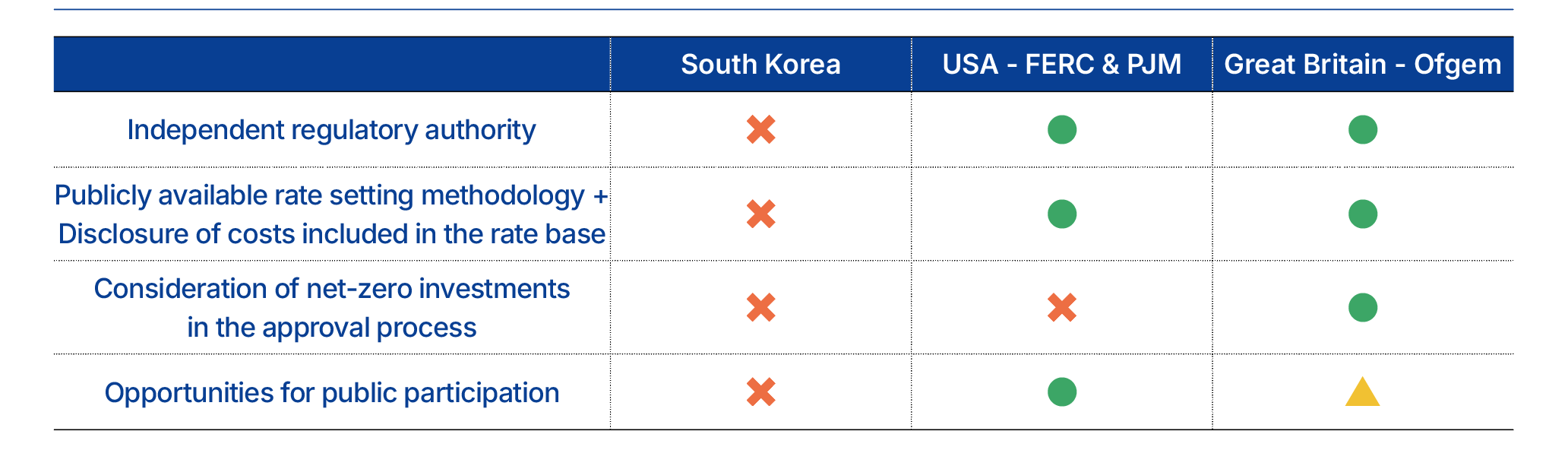
Introduce an independent regulatory body that oversees power grid planning and rate approval
Publish calculating methodologies for grid use fee rates, including disclosure of all costs which make up the rate base of power grid use tariffs and how the rate base is used to calculate the rates
Include requirements for planning and investments in grid enhancements for net-zero in the grid fee approval process
Allow open access to regulatory committee meetings and allow public feedback
Related research
Choosing a Green Steel Pathway : Implications for South Korea, Japan, and Australia
2026-09-14
KEPCO’s Financial Risks: When State-Owned Utilities Become an Economic Drag
2026-07-23
Steel in the Portfolio: An Engagement Framework for Institutional Investors
2026-06-16
Solving the Renewable Energy Disconnect: Enabling Korea’s 100GW RE Target Through Priority Grid Connection Policy
2026-06-01
Unlocking Agrivoltaics: Extending the Temporary Non-Agricultural Use Permission Period for Farmland
2026-05-14
Financing Strategies for Coal Phase-Out: Germany's Sovereign Green Bond Model and Implications for South Korea
2026-04-21
Recurring Crisis, Delayed Transition: From Fossil Fuel Dependence to Energy Independence
2026-03-18
Reforming South Korea's Power Sector: Setting the Stage For the Renewable Energy Transition
2026-02-04
Why LNG Reduction Matters: Redefining Energy Security and Unlocking Economic Gains
2025-12-08
South Korea’s Export Credit Finance in Transition: National Economic Impacts of the Global Shift from Fossil Fuels to Clean Energy
2025-11-16
Exposed: Overcompensation of KEPCO's Coal Fired Power Plants
2025-11-10
VPPs: The Key to Korea's Transition to a Renewable Energy-Based Power System
2025-08-28
Transition measures: the key to a successful transition to the OSW Special Act
2025-08-26
Accelerating Renewable PPAs in South Korea: 2025 Regulatory Updates and Unresolved Challenges
2025-08-06
Speed Bumps on the Renewable Energy Highway: Minimum Generation Levels of Thermal Power Plants
2025-08-05
Driving Hydrogen-Based Steelmaking in South Korea: Focus on Hydrogen Sourcing
2025-06-25

Can the Korean Semiconductor Industry Meet its Renewable Energy Targets? Policy Recommendations
2025-06-24

Analyzing Korea’s 2035 NDC GHG Emissions Reduction Pathway through an Integrated Assessment Model
2025-04-23

Green Premium - Out of Synch with Global GHG Protocol Standards
2025-02-16

Stronger Together: Unlocking Community Power for Lasting Change
2025-02-04

South Korea's PPA System: Status and Opportunities for Renewable Energy Development
2024-10-10

Issues with Fossil Fuel-Based Yongin National System Semiconductor Industrial Complex
2024-07-31

Improving the Governance of the Power System to Scale Up Renewables
2024-06-13

Current Issues in KPX’s Governance and Policy Proposal for Sustainable Change
2023-11-22
![[Report] Financing a Paris-Aligned Coal Exit in South Korea](https://content.sfoc.tapahalab.com/images/research/ld8wdme.jpg)
[Report] Financing a Paris-Aligned Coal Exit in South Korea
2023-06-01

Clean power in South Korea: A roadmap to zero fossil gas in South Korea’s power sector
2023-03-27

에너지 안보와 탄소중립을 위한 공정한 전력시장 발표자료집
2022-11-25
![[Consultation Brief] No Room for New Gas in South Korea](https://content.sfoc.tapahalab.com/images/research/uDmDeme.jpg)
[Consultation Brief] No Room for New Gas in South Korea
2022-11-22

Jeju's 2030 Carbon-Free Vision Begins With Renewable Curtailment Freedom
2022-09-22

Unbalanced Power Market: Analysis of how market structures discriminate against demand response in favor of gas power generation
2022-09-20
![[이슈브리프] 한전 적자 부추기는 전력시장 보상제도와 거버넌스](https://content.sfoc.tapahalab.com/images/research/FzvSdme.jpg)
[이슈브리프] 한전 적자 부추기는 전력시장 보상제도와 거버넌스
2022-08-24

Accelerating Corporate Renewable Electricity Procurement in Korea
2022-08-01
![[ISSUE BRIEF] Fossil Fuels, the Main Culprit behind KEPCO’s Deficit](https://content.sfoc.tapahalab.com/images/research/q5TSdme.jpg)
[ISSUE BRIEF] Fossil Fuels, the Main Culprit behind KEPCO’s Deficit
2022-06-03

Transforming the Korean Power Market to Reduce Renewable Curtailment
2022-05-03

RE100 Scheme Left Stranded, with Focus on High Network cost and Unreasonable Guidance on Trilateral PPAs
2021-12-23
![[이슈 브리프] 좌초되는 한국형 RE100 제도: 망이용료와 제3자 PPA를 중심으로](https://content.sfoc.tapahalab.com/images/research/etandme.jpg)
[이슈 브리프] 좌초되는 한국형 RE100 제도: 망이용료와 제3자 PPA를 중심으로
2021-12-14

Bridge to Death: Air Quality And Health Impacts of Fossil Gas Power
2021-11-19


