About
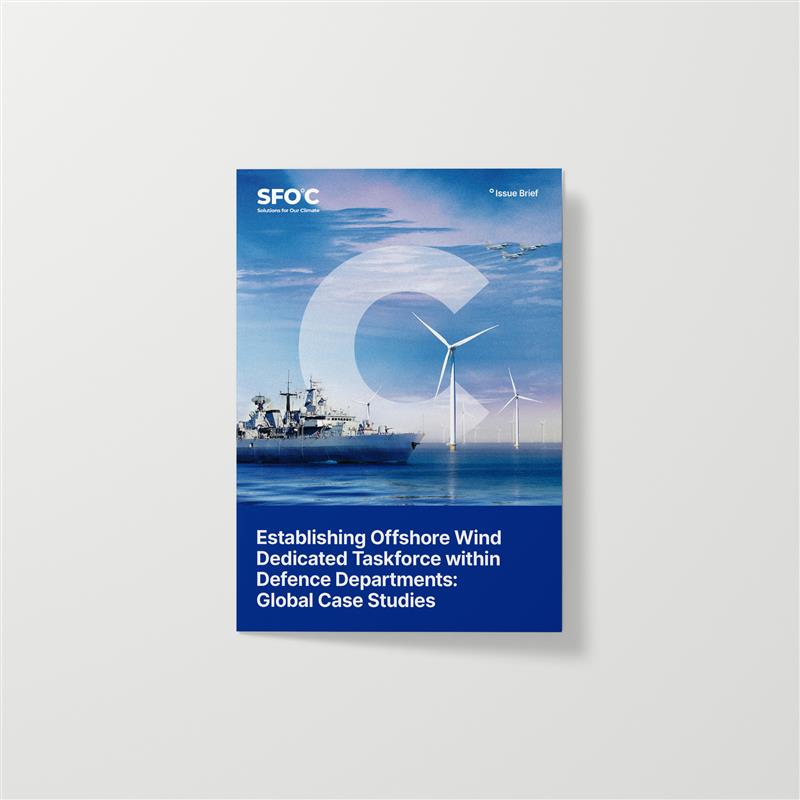
This brief examines how some countries operate dedicated taskforces within their Ministries of Defense to address recurring conflicts between offshore wind development and military operations.
Drawing on the UK Ministry of Defence’s Safeguarding system and the U.S. Department of Defense’s Clearinghouse, it analyzes how each country institutionalizes civil–military coordination and develops practical conflict-mitigation mechanisms. The UK’s Safeguarding team conducts early impact assessments, offers technical guidance, and coordinates design adjustments, supported by complementary private funding. The U.S. Clearinghouse functions as a single coordination platform, ensuring consistent engagement across the military, developers, federal agencies, and local communities, while integrating technical and R&D collaboration.
These cases show that early engagement, technical mitigation, policy coordination, and stable resourcing are essential to balancing military security with energy security — highlighting the need for Korea’s Ministry of National Defense to move beyond a passive review role toward strategic coordination.
As Korea prepares to implement its Special Act on the Promotion of Offshore Wind Power Distribution and Industrial Development, establishing a permanent, specialized civil–military coordination body is urgent. This brief offers recommendations for such an institution and emphasizes the importance of a governance framework that aligns energy security and military security.
Related research
Recurring Crisis, Delayed Transition: From Fossil Fuel Dependence to Energy Independence
2026-03-18
Transition measures: the key to a successful transition to the OSW Special Act
2025-08-26

Against the Current I: Public Waters Occupancy or Use Permit Processing Delays and Policy Recommendations
2025-02-18

Height Constraints in Offshore Wind: Current State and Challenges of the 500-Foot Limit in South Korea
2024-06-27

Renewable Energy Target Group Segmentation Survey Report in Korea
2024-05-14

12 Key Issues That Will Define Offshore Wind's Success in Korea
2023-12-04

Offshore Wind Colloquium Brief No.1 - UK case of Fisheries Engagement
2023-07-13

해상풍력 전력계통 연계 개선을 위한 세미나
2023-04-17

Up in the Air: Limitations of Korea's Offshore Permitting Process and Policy Recommendations
2023-02-13

재생에너지 출력제한 세미나
2022-09-27

2022 재생에너지 확대를 위한 정책 제안서
2022-01-26

Overseas Cases of Improvements to the Legal System for the Expansion of Renewable Energy
2021-11-30

풍력보급 활성화를 위한 RPS 제도개선 간담회
2021-09-13

Breezing Past Wind: How Korea's RPS is Sidelining the Wind Energy Market
2021-09-13

Employment opportunities from a coal-to-renewables transition in South Korea
2021-07-28


