POSCO’s reversal on limiting furnace repairs risks locking in coal-based steelmaking into the 2040s, undermining South Korea’s decarbonization ambitions.
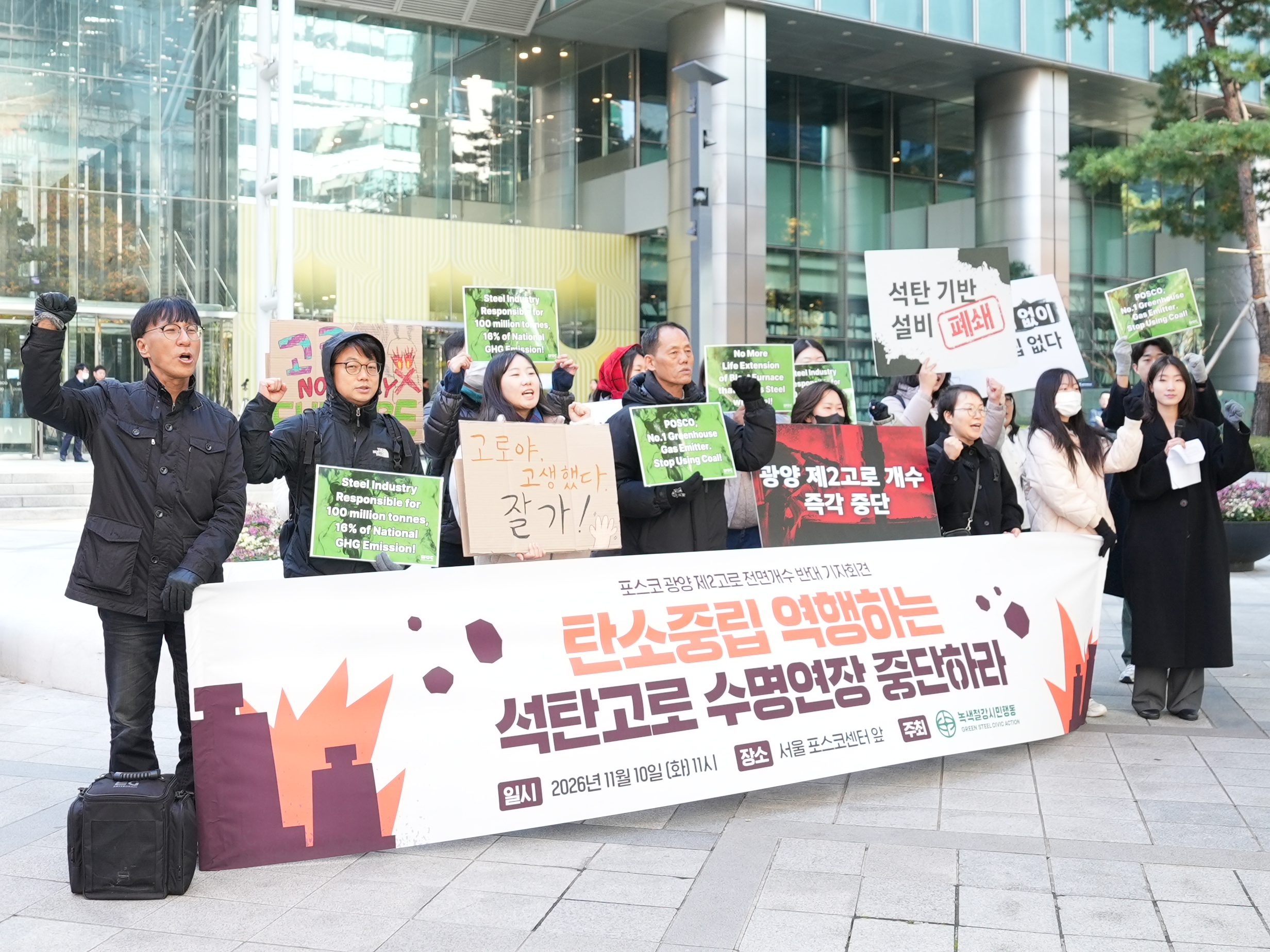
Image caption: Press conference outside POSCO Center in Seoul, hosted by the Green Steel Civic Action (GSCA). Image credit: SFOC.
November 10, 2026 (SEOUL) – Five young South Koreans have filed for an injunction to stop POSCO, the country’s top steelmaker and largest single corporate emitter, from carrying out a full reline of its Gwangyang Blast Furnace No. 2. The reline, which involves a major refurbishment of a blast furnace’s interior, would extend its lifespan by 15 to 20 years.
The filing was announced today at a press conference outside POSCO Center in Seoul, organized by Green Steel Civic Action (GSCA), a coalition of climate and environmental groups including the Korean Federation for Environmental Movements (KFEM) and its local chapters, Big Wave, Action Speaks Louder (ASL), and Solutions for Our Climate (SFOC).
POSCO announced last year that it would carry out a limited, partial reline of Gwangyang No. 2, but recent corporate disclosures and local media reports confirmed that it has since decided on a full reline, about 18 months later. The construction contract has also roughly tripled in value to ₩305.1 billion (around $223.7 million).
In a statement delivered at the press conference, the young applicants called for accountability, “When we talk about the climate crisis, we hear a lot about young people and future generations. But the decisions that determine how much carbon will be emitted in the future are being made right now, without us having any real say in them.”
“As young people, we do not want to inherit a future that has already been decided for us by generations before us. And we do not want our only role to be bearing the consequences of the climate crisis later.”
The injunction application seeks to suspend construction, which is expected to begin this month. According to the coalition, operating the furnace for another 15 years alone is expected to generate at least 137.02 million tons of additional CO₂ emissions, equivalent to the annual emissions of approximately 9.8 million South Koreans.
Yoon-Ah Ko, environmental lawyer at Jin & Lee representing the applicants said, “If the reline proceeds before a ruling is delivered in the main lawsuit, it could effectively lock in the continued operation of a high-carbon facility for the next 15 to 20 years. Once construction is complete, it would be hard to reverse, regardless of the outcome of the lawsuit. Therefore, to effectively protect the rights to a healthy environment and to life, construction must be halted until the main ruling.”
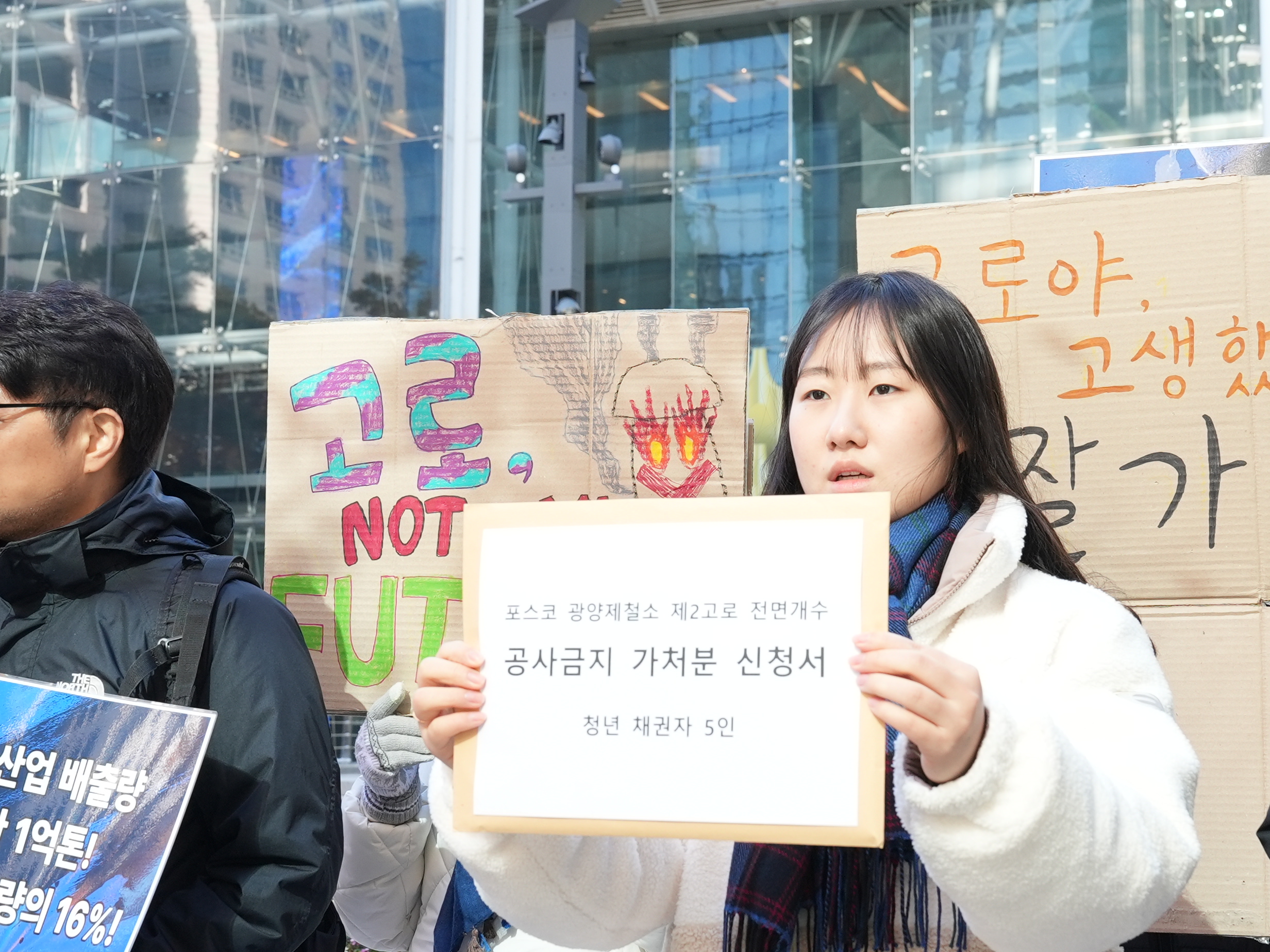
Image caption: Injunction filing was announced at the press conference outside POSCO Center in Seoul, hosted by the Green Steel Civic Action (GSCA). Image credit: SFOC.
This is not the first legal challenge to POSCO’s plans for Gwangyang Blast Furnace No. 2. A separate civil lawsuit was filed in February 2025 by ten other youth plaintiffs, aged 11 to 18 at filing, arguing that relining the furnace violates future generations’ rights to a healthy environment and to life.
In October 2026, POSCO presented a steel decarbonization project at the launch of the South Korean government’s K-GX green transformation strategy, which aims to turn decarbonization into a driver of industrial competitiveness. Yet just weeks later, it is moving ahead with a full reline that could keep a coal-based furnace operating into the 2040s, even as the EU’s Carbon Border Adjustment Mechanism (CBAM) makes carbon intensity an increasingly important factor for steel exporters. POSCO, in its media response to reports about the full reline, maintained that this does not disrupt its existing decarbonization transition plans.
The coalition is calling on POSCO to stop the full reline and publish furnace-by-furnace timelines for reducing production and closing its blast furnaces by 2050, along with plans for the resulting emissions reduction. It is also urging the company to redirect the budget allocated for blast furnace relining into low-carbon technologies, including hydrogen-based ironmaking.
Yang Guk Baek, Chairman, Korean Federation for Environmental Movements in Gwangyang (KFEM Gwangyang), said, “POSCO says its decision to reline the blast furnace was driven by economic considerations, but residents of Gwangyang have already endured more than 40 years of environmental harm. It is time for POSCO to make decisions that genuinely prioritize the environment and the future, as it publicly claims to do. The company must not continue to place the burden of its operations on local communities.”
Hyesung An, Steel Researcher, Solutions for Our Climate (SFOC), said, “POSCO’s decision to fully reline Gwangyang Blast Furnace No. 2 risks locking the company into coal-based steelmaking for decades, undermining both its decarbonization commitments and its long-term competitiveness. POSCO must reconsider the relining decision, clearly disclose its plans and timelines for phasing out coal-based assets, and commit to measurable milestones against which investors and other stakeholders can hold the company accountable.”
ENDS.
Solutions for Our Climate (SFOC) is an independent nonprofit organization that works to accelerate global greenhouse gas emissions reduction and energy transition. SFOC leverages research, litigation, community organizing, and strategic communications to deliver practical climate solutions and build movements for change.
Photos from the press conference can be found here (image credit: SFOC).
For media inquiries, please reach out to:
Niyati Shetty, International Communications Officer, niyati.shetty@forourclimate.org
Kate Kalinova, International Communications Officer, kate.kalinova@forourclimate.org
Share this insights