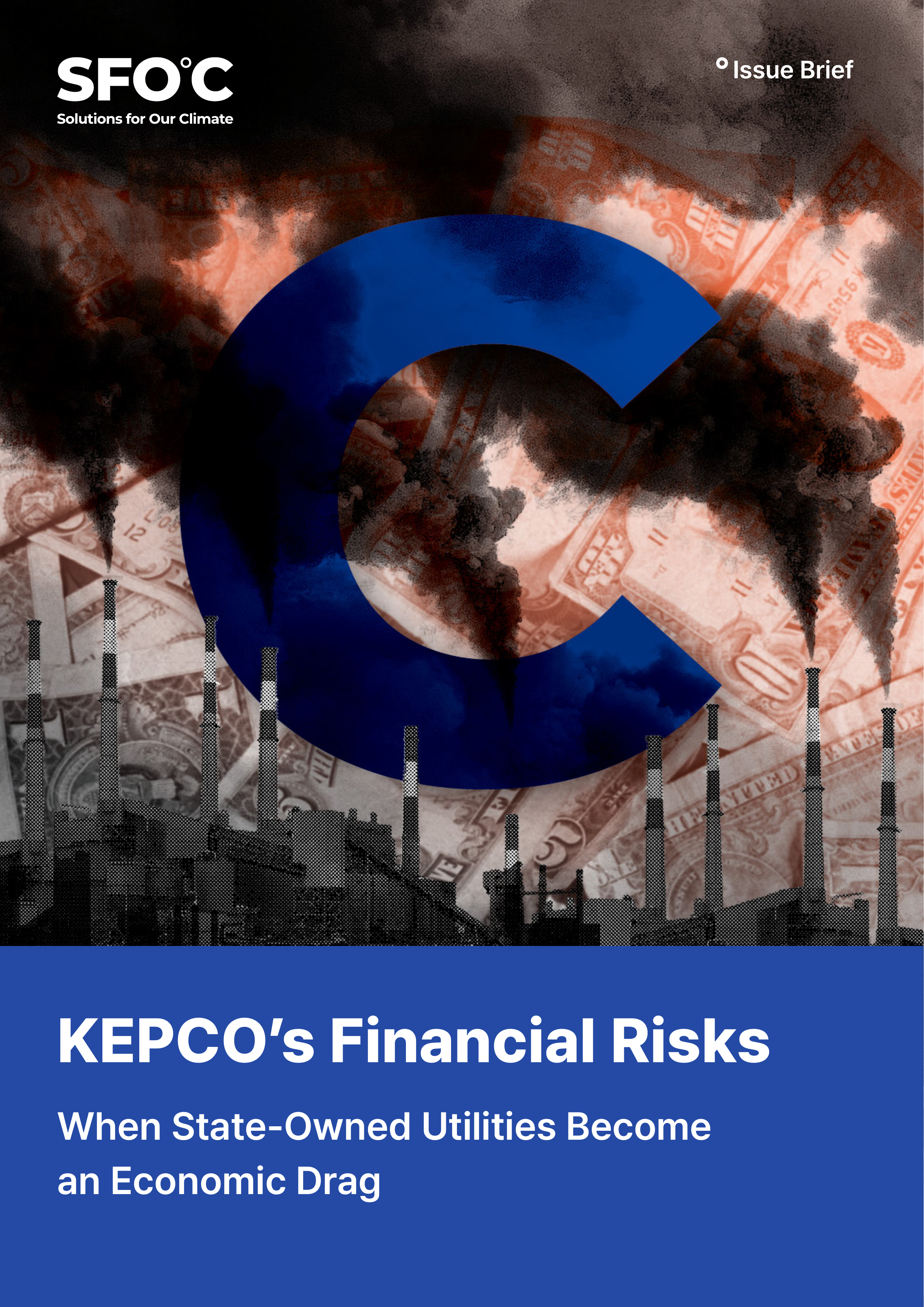
KEPCO’s Financial Risks: When State-Owned Utilities Become an Economic Drag

About
For decades, the giant state-owned utilities supported Korea’s economic growth under a fossil fuel-based system. Yet in a world increasingly shaped by the climate crisis, KEPCO has failed to keep pace with the energy transition. Relying on sovereign-backed borrowing to absorb energy price shocks is no longer sustainable in times of fragile financial markets and recurring energy crises.
Executive summary
KEPCO’s heavy reliance on coal and gas exposed it to the 2022 energy crisis, resulting in operating losses of up to USD 26 billion, a debt-to-equity ratio exceeding 600%, and record bond issuance that accounted for over 20% of Korea’s corporate bond market.
Although profitability improved in 2024–2025 following electricity tariff increases, KEPCO remains vulnerable to fuel price volatility, exchange-rate fluctuations, and the risk of breaching statutory bond issuance limits.
KEPCO’s recent earnings recovery has been driven primarily by higher industrial electricity tariffs rather than structural improvements.
Industrial electricity sales are declining as companies increasingly procure electricity through alternative channels, including power purchase agreements (PPAs), undermining KEPCO’s long-term revenue base.
The current power market structure creates a significant imbalance: while KEPCO accumulated USD 29 billion in operating losses between 2021 and 2025, state-owned generators and private power producers continued to earn substantial profits and improve their financial conditions.
Over the same period, Thermal GENCOs earned cumulative operating profits of USD 4.85 billion, KHNP earned USD 4.72 billion, and major private gas-fired generators earned USD 5.36 billion.
While KEPCO’s debt burden rose sharply, the debt-to-equity ratios of generators improved significantly, indicating that financial risks are disproportionately concentrated on KEPCO.
Recent increases in oil prices, LNG prices, and exchange rates suggest KEPCO’s financial performance could be significantly weaker than its downside projections.
Under a downside scenario, KEPCO’s bond issuance ratio could remain around 250% after 2027, exceeding the statutory limit even after the temporary expansion of bond issuance capacity expires.
The Korean government should closely monitor KEPCO’s statutory bond issuance risk and its implications for financial market stability.
Beyond electricity tariff adjustments, policymakers should reform power market rules and compensation mechanisms that currently allow generators to remain profitable while concentrating debt burdens on KEPCO.
Structural reforms are needed to reduce fossil fuel dependence, improve KEPCO’s financial sustainability, and support Korea’s energy transition.
KEPCO’s recurring debt crises highlight the unsustainability of a fossil fuel-dependent electricity system and the growing financial risks associated with relying on government-backed borrowing to absorb energy price shocks.
Related research
Hidden Methane Emissions, Tangible Economic Costs: Lost Fuel Value and Heatwave-Related Climate Damages from Japan’s Imported Fossil Fuel Supply Chains
2026-08-03
![[SFOC] Hidden Methane Emissions, Tangible Economic Costs: Lost Fuel Value and Heatwave-Related Climate Damages from Korea’s Imported Fossil Fuel Supply Chains](https://content.forourclimate.org/images/research/yUNyzaf.jpg)
[SFOC] Hidden Methane Emissions, Tangible Economic Costs: Lost Fuel Value and Heatwave-Related Climate Damages from Korea’s Imported Fossil Fuel Supply Chains
2026-08-03
The Undisclosed Bill: How Hyundai Motor Group is accruing a CBAM liability it has not quantified for investors
2026-07-15
Status of the National Pension Service’s Stewardship Activities and Recommendations for a Climate Stewardship Code
2026-07-06
Steel in the Portfolio: An Engagement Framework for Institutional Investors
2026-06-16
Solving the Renewable Energy Disconnect: Enabling Korea’s 100GW RE Target Through Priority Grid Connection Policy
2026-06-01
Stewardship Without Climate : Reforming Korea’s Stewardship Code
2026-05-13
Financing Strategies for Coal Phase-Out: Germany's Sovereign Green Bond Model and Implications for South Korea
2026-04-21
Recurring Crisis, Delayed Transition: From Fossil Fuel Dependence to Energy Independence
2026-03-18
Reforming South Korea's Power Sector: Setting the Stage For the Renewable Energy Transition
2026-02-04
Settled in Secret: The Opaque Grid Fee System Undermining Renewable Energy PPA Expansion in South Korea
2025-12-01
From Words to Data: Bridging Hyundai’s Climate Commitments and Disclosure
2025-11-28
Exposed: Overcompensation of KEPCO's Coal Fired Power Plants
2025-11-10
Supplementary Brief: South Korea's Exposure to Shipping Stranded Asset Risks
2025-10-26
Mobilizing Finance for Korea's Coal Phase-Out: What International Experience Shows
2025-10-20
VPPs: The Key to Korea's Transition to a Renewable Energy-Based Power System
2025-08-28
Accelerating Renewable PPAs in South Korea: 2025 Regulatory Updates and Unresolved Challenges
2025-08-06
Speed Bumps on the Renewable Energy Highway: Minimum Generation Levels of Thermal Power Plants
2025-08-05

Can the Korean Semiconductor Industry Meet its Renewable Energy Targets? Policy Recommendations
2025-06-24

Analyzing Korea’s 2035 NDC GHG Emissions Reduction Pathway through an Integrated Assessment Model
2025-04-23

Capitalizing on Coal: How Global Investors and Underwriters Enable KEPCO to Abandon the Sustainability Path
2025-03-20

Moving Away from Coal: 2025 POSCO Holdings Climate Risk
2025-03-17

A Sleeping Giant? The National Pension Service’s Missed Potential on Climate Action
2025-03-11

Green Premium - Out of Synch with Global GHG Protocol Standards
2025-02-16

Stronger Together: Unlocking Community Power for Lasting Change
2025-02-04

Extending the Lifespan of Gwangyang No.2 Blast Furnace: A Backward Step for Carbon Neutrality
2024-10-28

South Korea's PPA System: Status and Opportunities for Renewable Energy Development
2024-10-10

Issues with Fossil Fuel-Based Yongin National System Semiconductor Industrial Complex
2024-07-31

Improving the Governance of the Power System to Scale Up Renewables
2024-06-13

Boom and Bust Coal 2024
2024-04-17

Current Issues in KPX’s Governance and Policy Proposal for Sustainable Change
2023-11-22
![[Report] Financing a Paris-Aligned Coal Exit in South Korea](https://content.sfoc.tapahalab.com/images/research/ld8wdme.jpg)
[Report] Financing a Paris-Aligned Coal Exit in South Korea
2023-06-01

Clean power in South Korea: A roadmap to zero fossil gas in South Korea’s power sector
2023-03-27

에너지 안보와 탄소중립을 위한 공정한 전력시장 발표자료집
2022-11-25
![[Consultation Brief] No Room for New Gas in South Korea](https://content.sfoc.tapahalab.com/images/research/uDmDeme.jpg)
[Consultation Brief] No Room for New Gas in South Korea
2022-11-22

Jeju's 2030 Carbon-Free Vision Begins With Renewable Curtailment Freedom
2022-09-22

Unbalanced Power Market: Analysis of how market structures discriminate against demand response in favor of gas power generation
2022-09-20
![[이슈브리프] 한전 적자 부추기는 전력시장 보상제도와 거버넌스](https://content.sfoc.tapahalab.com/images/research/FzvSdme.jpg)
[이슈브리프] 한전 적자 부추기는 전력시장 보상제도와 거버넌스
2022-08-24

Accelerating Corporate Renewable Electricity Procurement in Korea
2022-08-01
![[ISSUE BRIEF] Fossil Fuels, the Main Culprit behind KEPCO’s Deficit](https://content.sfoc.tapahalab.com/images/research/q5TSdme.jpg)
[ISSUE BRIEF] Fossil Fuels, the Main Culprit behind KEPCO’s Deficit
2022-06-03

Transforming the Korean Power Market to Reduce Renewable Curtailment
2022-05-03

RE100 Scheme Left Stranded, with Focus on High Network cost and Unreasonable Guidance on Trilateral PPAs
2021-12-23
![[이슈 브리프] 좌초되는 한국형 RE100 제도: 망이용료와 제3자 PPA를 중심으로](https://content.sfoc.tapahalab.com/images/research/etandme.jpg)
[이슈 브리프] 좌초되는 한국형 RE100 제도: 망이용료와 제3자 PPA를 중심으로
2021-12-14
![[토론회] 한국형 녹색분류체계(K-Taxonomy), 무엇이 녹색경제활동인가](https://content.sfoc.tapahalab.com/images/research/bn8jdme.jpg)
[토론회] 한국형 녹색분류체계(K-Taxonomy), 무엇이 녹색경제활동인가
2021-11-23

Bridge to Death: Air Quality And Health Impacts of Fossil Gas Power
2021-11-19
![[이슈 브리프] 탈석탄 투자 가이드라인](https://content.sfoc.tapahalab.com/images/research/tJRidme.jpg)
[이슈 브리프] 탈석탄 투자 가이드라인
2021-09-13
![[이슈 브리프] 신설 석탄발전소 가치평가 결과와 시사점](https://content.sfoc.tapahalab.com/images/research/nQCGime.jpg)
[이슈 브리프] 신설 석탄발전소 가치평가 결과와 시사점
2021-09-06

Employment opportunities from a coal-to-renewables transition in South Korea
2021-07-28


