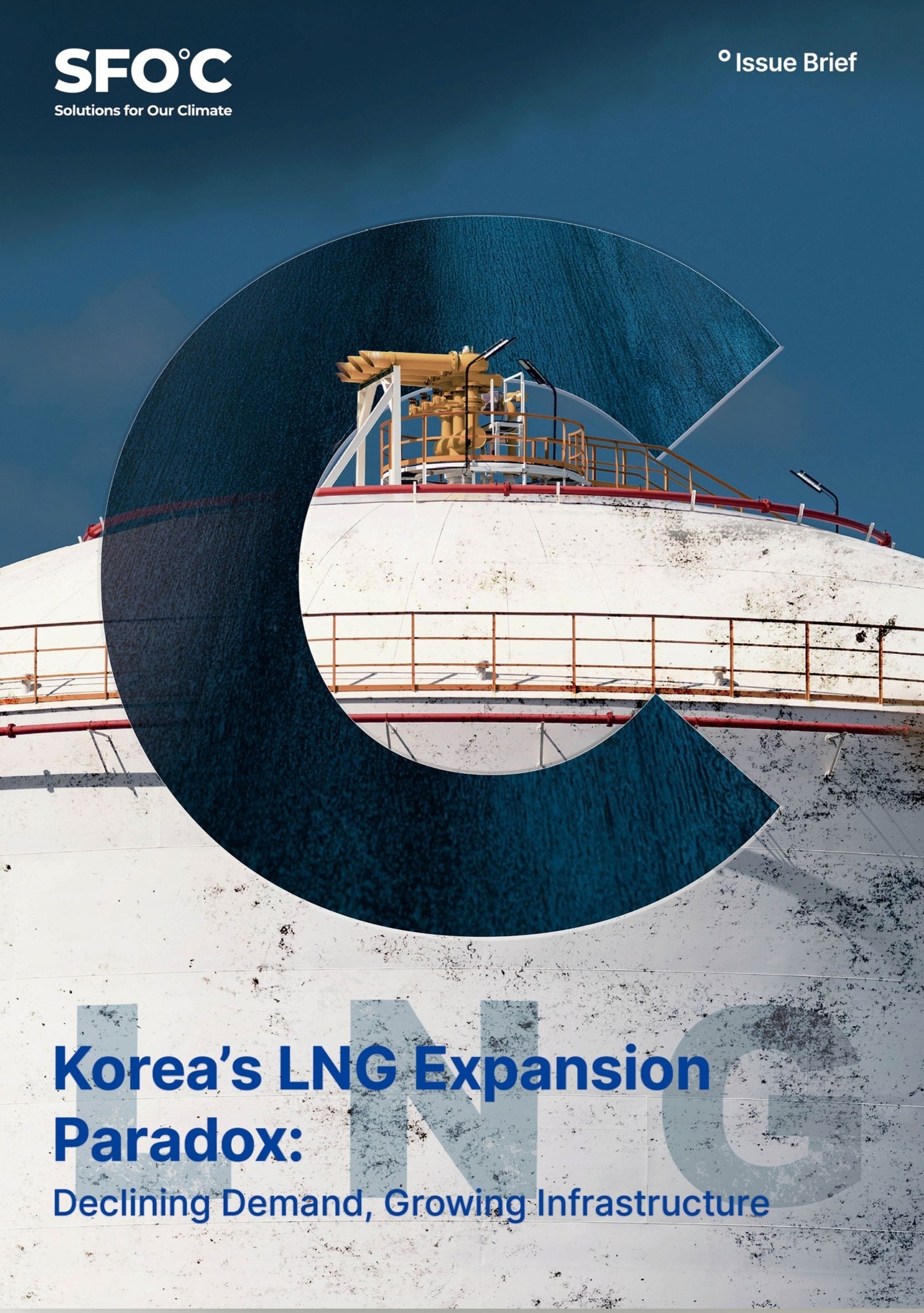
Korea's LNG Expansion Paradox: Declining Demand, Growing Infrastructure

About
This issue brief, Korea's LNG Expansion Paradox, examines whether the Korea Gas Corporation's (KOGAS) LNG infrastructure expansion on the grounds of energy security is genuinely justified and asks what Korea's experience signals for LNG exporters and financiers upstream who increasingly count on Korean demand.
Recent geopolitical shocks have renewed price volatility and supply uncertainty in the LNG market, exposing its structural instability. In response, energy-importing countries such as Korea are accelerating their shift to renewable energy and consequently expect a long-term decline in gas demand. Yet against this trend, KOGAS continues to build new LNG import infrastructure despite questions over whether that expansion is needed.
Our analysis finds that KOGAS's existing terminals already meet, and in several cases far exceed, both current demand and the country's energy-security requirements - in regasification and storage capacity. The problem is not a shortage of LNG infrastructure, but the pursuit of additional capacity while substantial LNG assets already sit idle.
The implication reaches well beyond Korea. As the world's third-largest LNG importer, Korea is routinely cited as a pillar of "durable Asian demand" used to justify new export terminals, liquefaction plants and upstream gas fields worldwide. If a mature buyer is already overbuilt and facing declining demand, the stranded-asset risk does not stop at Korea's shoreline: it propagates downstream across the entire LNG value chain, including projects in Australia and Canada where Korean companies hold equity.
Korea, in short, may be an early warning of how quickly demand assumptions can diverge from market reality during the energy transition. This brief sets out that evidence and calls for an urgent review of how efficiently existing terminals are used before any further expansion proceeds.
Download report
Executive summary
The Korea Gas Corporation (KOGAS) currently operates five LNG terminals across Korea (Pyeongtaek, Incheon, Samcheok, Tongyeong, and Jeju) and is pursuing further expansion of LNG infrastructure on the grounds of energy security. One such project is the Dangjin LNG Terminal, which has been justified by the need to ensure stable gas supply to the nearby Seoul metropolitan area.
However, analysis shows that the average utilization rate of KOGAS LNG terminals are significantly low at approximately 27% over the last two years (2024–2025). Even during the high winter season, utilization rates at the two terminals serving the Seoul metropolitan region (Pyeongtaek and Incheon) averaged only 41% and 32%, respectively. Underutilization of KOGAS LNG terminals is also evident during peak transmission hours, with data showing 17% to 44% of capacity left unused during these times in 2024. These findings illustrate the need to assess Korea’s LNG infrastructure needs using long-term utilization patterns rather than just looking at short-term peak-demand metrics.
Regarding storage, Korea’s existing LNG terminals already exceed the government's energy security objectives. Current KOGAS storage capacity can provide approximately 55 days of gas supply based on 2025 annual transmission volumes; and 38 days of supply based on 2025 winter transmission volumes. Both figures are much higher than Korea’s legal LNG stockpiling requirement of nine days.
Meanwhile Korea’s 16th Long-Term Natural Gas Supply and Demand Plan projects domestic gas demand to decline by approximately 11.3% from 2026 to 2038. In this context, the inefficiencies of Korea’s LNG terminals are likely to deteriorate further. As a result, even the already low utilization rate of 26% assumed in the preliminary feasibility assessment for the Dangjin LNG Terminal may prove difficult to achieve, increasing the risk that the project will fail to recover its $2.3 billion USD (₩3.4 trillion KRW) investment over its operating lifetime.
The Dangjin LNG Terminal is not an isolated case but a symptom of broader structural issues. Despite low utilization rates and excessive storage capacity, the expansion of LNG infrastructure across Korea continues, and assumptions of continued Korean gas demand remains an important justification for LNG development both domestically and internationally.
This raises questions not only for Korea's infrastructure planning, but also for the global LNG industry. Lower-than-expected Korean demand could challenge investment decisions across the LNG value chain, increasing stranded asset risks for exporters, project developers, financiers, and import infrastructure well beyond Korea. Therefore, it is important for exporters to distinguish the expansion of LNG import infrastructure in Korea in the short term from the anticipated demand decline in the medium to long term.
Importantly, the additional energy security benefits provided by the Dangjin LNG Terminal are limited, and the project has diverted financial resources away from renewable energy deployment and expansion which could have made more meaningful contributions toward both energy security and climate objectives.
On the basis of these findings, this issue brief proposes three policy recommendations:
Align Korea’s LNG infrastructure planning with projected demand and energy transition policies
Avoid overbuilding across the LNG value chain.
Prioritise energy security investments that reduce import dependence.
Related research
Hidden Methane Emissions, Tangible Economic Costs: Lost Fuel Value and Heatwave-Related Climate Damages from Japan’s Imported Fossil Fuel Supply Chains
2026-08-03
![[SFOC] Hidden Methane Emissions, Tangible Economic Costs: Lost Fuel Value and Heatwave-Related Climate Damages from Korea’s Imported Fossil Fuel Supply Chains](https://content.forourclimate.org/images/research/yUNyzaf.jpg)
[SFOC] Hidden Methane Emissions, Tangible Economic Costs: Lost Fuel Value and Heatwave-Related Climate Damages from Korea’s Imported Fossil Fuel Supply Chains
2026-08-03
An Assessment of Environmental and Social Impacts of LNG Carriers
2026-04-06
Recurring Crisis, Delayed Transition: From Fossil Fuel Dependence to Energy Independence
2026-03-18
The Changing Legal Landscape for LNG Shipping Expansion
2026-01-08
Why LNG Reduction Matters: Redefining Energy Security and Unlocking Economic Gains
2025-12-08
South Korea’s Export Credit Finance in Transition: National Economic Impacts of the Global Shift from Fossil Fuels to Clean Energy
2025-11-16
Supplementary Brief: South Korea's Exposure to Shipping Stranded Asset Risks
2025-10-26
VPPs: The Key to Korea's Transition to a Renewable Energy-Based Power System
2025-08-28
Bridge to Nowhere: The Doomed Fate of Korea's LNG Terminals
2025-08-19
Speed Bumps on the Renewable Energy Highway: Minimum Generation Levels of Thermal Power Plants
2025-08-05

No Room for More: Why LNG Carriers Are a Climate and Financial Risk
2025-05-13

Analyzing Korea’s 2035 NDC GHG Emissions Reduction Pathway through an Integrated Assessment Model
2025-04-23

Missing points of “South Korea’s East Sea Blue Whale Project”
2025-01-08

Socio-economic Impacts of Energy Transition in Chungcheongnam-do
2024-12-18

Still Adrift: Updated assessment of the global energy transition's impact on the LNG shipbuilding industry
2024-10-14

Billions Off Course: Japan's Oil and Gas Financing Fueling the Climate Crisis
2024-09-05

Floating Doubt: The Risks of FSRUs in Expanding Methane Gas
2024-09-03

LNG運搬船: 世界のガス取引を拡大させる海上パイプライン ――影の推進者を明らかにする
2024-06-12

Three Unseen Flaws of the Boryeong Blue Hydrogen Project in South Korea
2024-05-26

Threat of Toxic Substances: Increased Particulate Matter and Health Hazards from Ammonia Co-firing
2024-05-22
![[Brief] South Korea’s international public finance continues to block a just energy transition](https://content.sfoc.tapahalab.com/images/research/RC5Kime.jpg)
[Brief] South Korea’s international public finance continues to block a just energy transition
2024-04-02

Total Turmoil: Unveiling South Korea's Stake in Mozambique's Climate and Humanitarian Crisis
2024-01-29

LNG Carriers: The Floating Pipeline Powering Global Gas Expansion - Unveiling its Hidden Enablers
2023-11-27

High and dry:The global energy transition's looming impact on the LNG and oil shipbuilding industry
2023-05-24

Betting on a Sinking Ship: Banks Behind the Barossa Gas Field’s FPSO
2023-04-18

Unveiling Fossil Greenwashing: Hidden Emissions of Korea's Hydrogen Scheme
2022-09-13
![[토론회] 한국형 녹색분류체계(K-Taxonomy), 무엇이 녹색경제활동인가](https://content.sfoc.tapahalab.com/images/research/bn8jdme.jpg)
[토론회] 한국형 녹색분류체계(K-Taxonomy), 무엇이 녹색경제활동인가
2021-11-23
![[이슈 브리프] 탄소포집, 이용 및 저장기술(CCUS) 현황과 문제점](https://content.sfoc.tapahalab.com/images/research/SWESdme.jpg)
[이슈 브리프] 탄소포집, 이용 및 저장기술(CCUS) 현황과 문제점
2021-11-03

KR-DE Road to 2050 : Financing Clean Energy Transition
2021-09-28

Fueling the Climate Crisis_South Korea's Public Financing for Oil and Gas
2021-08-31


