Comparative assessment of six Asian countries reveals persistent gaps in methane capture, biogas recovery, and landfill gas utilization
Report identifies household waste separation, sanitary landfills, and recycling as the region's clearest near-term opportunities for methane reduction
June 5, 2026 (SEOUL) - Asia is projected to record the world's largest increase in waste-sector methane emissions by 2030, having already generated an estimated 684.5 Mt CO₂-e in 2024. Yet despite the availability of proven methane mitigation measures already operating at scale in parts of the region, a new report released today finds that fragmented governance, uneven policy implementation, and infrastructure constraints continue to hamper efforts to curb emissions from the waste sector.
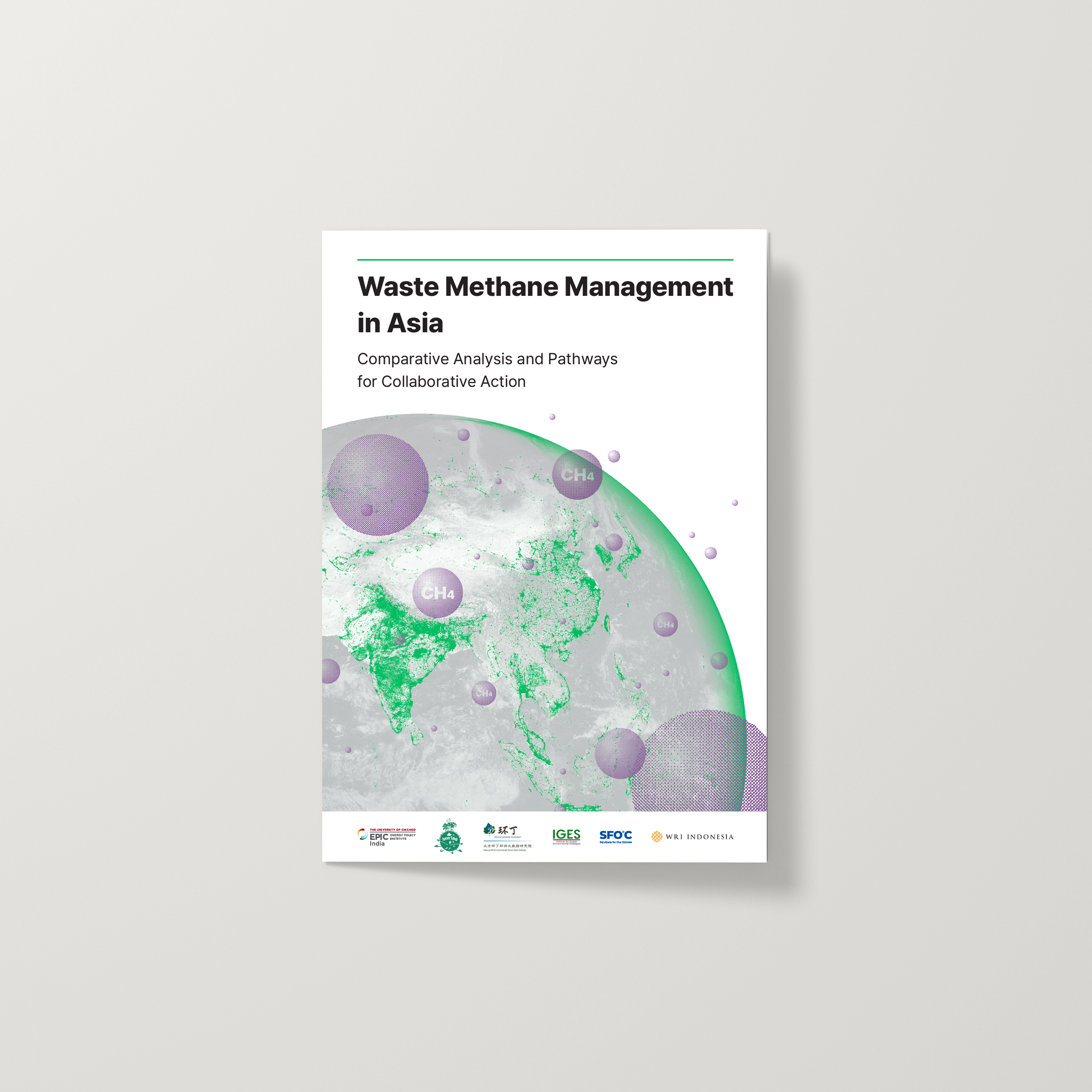
The report, “Waste Methane Management in Asia: Comparative Analysis and Pathways for Collaborative Action”, examines waste methane management systems in South Korea, Japan, China, Malaysia, Indonesia, and India. Through a comparative assessment of waste segregation and collection, landfill management, waste processing and recovery, wastewater treatment and cross-cutting themes, the report finds that methane reduction outcomes are shaped less by the availability of technical solutions than by institutional coordination, financing capacity, operational consistency, and governance design.
Methane is one of the most powerful drivers of near-term global warming, responsible for nearly 0.5°C of temperature rise to date despite remaining in the atmosphere for only around 12 years. Because its warming potential is 86 times greater than carbon dioxide over a 20-year period, reducing methane emissions is widely regarded as one of the fastest and most cost-effective opportunities to slow climate change.
The waste sector accounts for approximately one-fifth of global anthropogenic methane emissions and offers substantial mitigation potential through proven measures such as waste segregation, landfill management, methane capture, and wastewater treatment.
The analysis shows that while all six countries have adopted methane mitigation measures in different forms, implementation remains uneven across sectors and jurisdictions. In many cases, policies exist on paper, but fragmented responsibilities between national and local authorities, inconsistent enforcement, and infrastructure gaps continue to undermine emissions reductions.
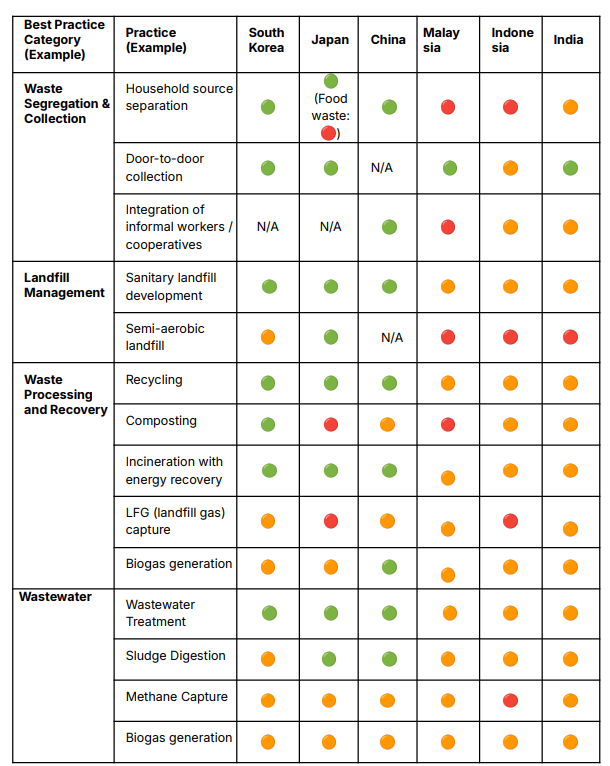
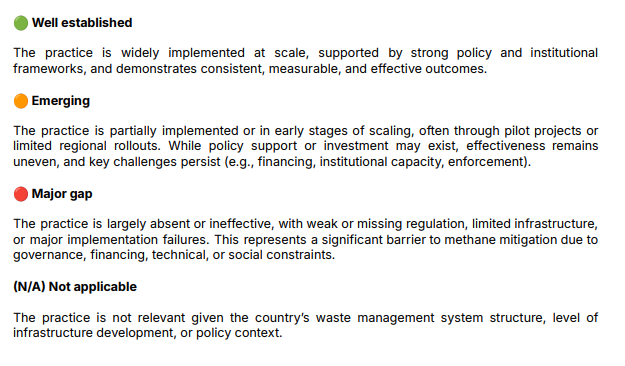
Table 1: Comparative Assessment of Waste Methane Management Across Six Countries
The report finds that while South Korea, Japan, and China generally demonstrate more established waste management systems, each country's strengths and challenges reflect different policy choices, infrastructure pathways, and governance arrangements.
South Korea and Japan stand out for their institutionalized waste segregation and collection systems, which are supported by stable regulatory frameworks, municipality-led collection systems, and high levels of public participation. Both countries have also developed engineered landfill systems, although South Korea continues to face landfill capacity pressures while Japan grapples with land constraints and the costs associated with maintaining controlled landfill facilities.
China demonstrates the scale of policy-driven waste sector transformation. Mandatory waste separation policies have been introduced across hundreds of cities, while sanitary landfill modernization, recycling systems, biogas generation, and wastewater treatment infrastructure have expanded significantly. However, ensuring consistent implementation across jurisdictions and maintaining the integrity of separated waste streams remain ongoing challenges.
Malaysia, Indonesia, and India illustrate the diverse implementation challenges facing rapidly developing waste management systems. Malaysia has established high-standard sanitary landfill facilities and wastewater treatment infrastructure, but source separation and methane recovery remain unevenly implemented. Indonesia has developed innovative community-based approaches, including waste banks and local recovery systems, though sanitary landfill coverage and methane capture infrastructure remain limited. India has demonstrated progress through city-level segregation, recycling, and wastewater initiatives, but outcomes continue to vary significantly across municipalities due to differences in capacity, financing, and infrastructure.
Across all six countries, the report finds that no single waste methane management model emerges as universally applicable. Instead, performance is shaped by institutional coordination, financing structures, infrastructure maturity, and operational capacity. While household waste separation, sanitary landfill development, and recycling have been successfully institutionalized in several countries, methane capture, landfill gas recovery, and biogas generation remain common areas for improvement.
To address these implementation gaps, the report outlines a pathway for regional cooperation, arguing that waste methane mitigation cannot be addressed through isolated projects or one-size-fits-all solutions. Instead, it calls for a stepwise approach that begins with awareness-building and knowledge-sharing, followed by technical capacity-building, city-level pilot projects supported by targeted financing, stronger policy integration, and robust monitoring and verification systems.
While countries across the region face different waste management challenges, the report finds significant opportunities for peer-to-peer learning and cooperation, particularly in areas such as household waste separation, sanitary landfill development, recycling, landfill gas recovery, and wastewater methane management. The report concludes that stronger regional collaboration can help bridge implementation gaps and accelerate the deployment of proven methane mitigation measures across Asia.
The report identifies household waste separation, sanitary landfill development, and recycling as the region's clearest near-term opportunities for collaboration, noting that these practices have already been institutionalized at scale in several countries and could be adapted to local contexts elsewhere in Asia. Stronger regional cooperation, the report argues, can help bridge implementation gaps and accelerate methane reductions across one of the world's fastest-growing sources of waste-sector emissions.
The report was developed through a regional collaboration involving researchers from various organizations across Asia, including Sanghyun Ma of Solutions for Our Climate (SFOC), Miho Hayashi and Chen Liu of the Institute for Global Environmental Strategies (IGES), Lijin Zhong of the Beijing Huanding Environmental Smart Data Institute, Ben Gutierrez of Forever Sabah, Khalisha Qatrunnada and Aisyah Lestari of the World Resources Institute Indonesia (WRI Indonesia), and Swarna Dutt and Suyash Nandgaonkar of the Energy Policy Institute at the University of Chicago (EPIC India).
ENDS
Solutions for Our Climate (SFOC) is an independent nonprofit organization that works to accelerate global greenhouse gas emissions reduction and energy transition. SFOC leverages research, litigation, community organizing, and strategic communications to deliver practical climate solutions and build movements for change.
For media inquiries, please reach out to:
Antonette Tagnipez, International Communications Officer, at antonette.tagnipez@forourclimate.org
Share this insights
![[SFOC] Hidden Methane Emissions, Tangible Economic Costs: Lost Fuel Value and Heatwave-Related Climate Damages from Korea’s Imported Fossil Fuel Supply Chains](https://content.forourclimate.org/images/research/GbNyzaf.jpg)



![[Report] Methane Reduction Strategies and Regulations in South Korea: Current Issues and Policy Recommendations](https://content.sfoc.tapahalab.com/images/research/xxJgdme.jpg)


