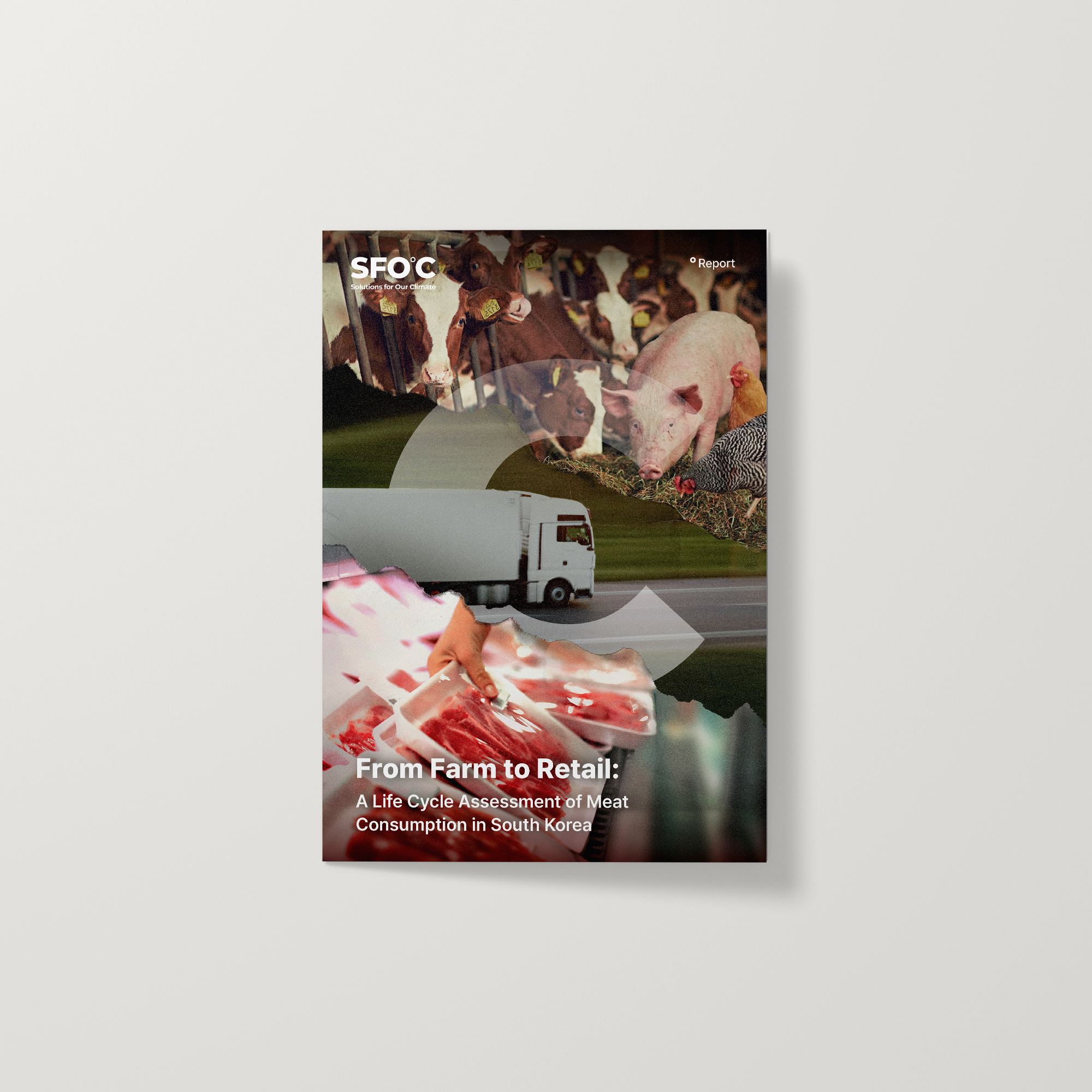
May 15, 2026 (SEOUL) - A new life cycle assessment (LCA) study published by Solutions for Our Climate (SFOC) has found that South Korea's annual per capita meat consumption reaches 61.4 kg, generating approximately 1,115 kg CO₂-equivalent in greenhouse gas (GHG) emissions. This is equivalent to the climate impact of taking 21 one-way flights between Gimpo and Jeju Island every year.
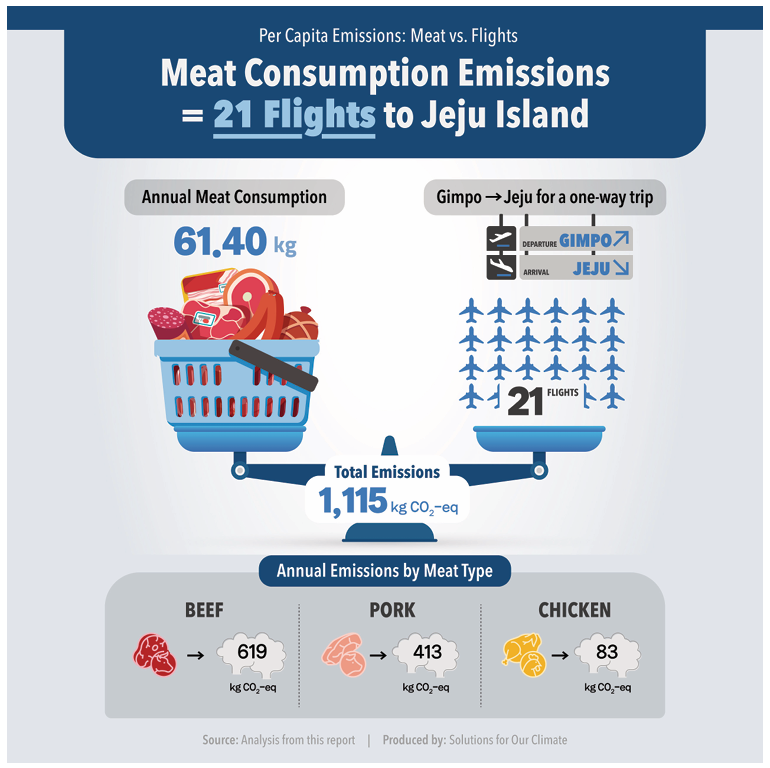
Figure 1: Climate Report Card: The Impact of National Per Capita Meat Consumption
The report, “From Farm to Retail: A Life Cycle Assessment of Meat Consumption in South Korea,” is the first to apply a comprehensive “Cradle-to-Retail” framework to South Korea’s meat supply chain, capturing emissions generated across the entire lifecycle of meat products – from farming and slaughtering to processing, and retail distribution. The analysis highlights major gaps in South Korea’s current greenhouse gas accounting system for livestock products, which largely focuses on direct farm-level emissions while overlooking emissions generated further along the supply chain.
The findings show that beef consumption accounts for the majority of meat-related emissions in South Korea. Although Koreans consume roughly twice as much pork as beef by weight, beef accounts for approximately 55% of total meat consumption emissions due to its disproportionately large carbon footprint. Producing one kilogram of beef generates approximately 58.15 kg CO₂-eq, around 4.4 times more than pork and 10.8 times more than chicken.
The report also found that South Korea’s total beef consumption reached 766,000 tonnes in 2024, with imported beef accounting for approximately 60% of the domestic supply. Imported beef alone surpassed 420,000 tonnes, generating an estimated 12.52 million tonnes of CO₂-equivalent emissions annually.
These emissions have long remained obscured within global supply chains and are largely absent from domestic climate discussions. Given South Korea’s heavy reliance on imported beef, the report warns that the country’s consumption patterns represent a significant and growing source of national-scale emissions.
South Korea’s current greenhouse gas accounting framework primarily captures emissions generated directly at the farm level, leaving out substantial emissions associated with slaughtering, processing, refrigeration, logistics, and long-distance maritime transport linked to imported meat products. Because these post-farm emissions are dispersed across sectors such as industry, transportation, and energy, the true climate impact of meat products at the retail level has remained effectively invisible to the public. As a result, this fragmented structure of carbon emissions data within the meat industry leads to carbon data asymmetry, leaving consumers who regularly purchase meat from retail stores insufficiently informed about the climate impacts at the point of purchase.
South Korea’s beef consumption stands out among East Asian neighbors
South Korea’s annual per capita beef consumption reached 15 kilograms in 2024, the highest among major East Asian countries. This is approximately 2.5 times higher than Japan’s annual per capita beef consumption of 5.9 kilograms and nearly 3.8 times higher than China’s 3.9 kilograms.
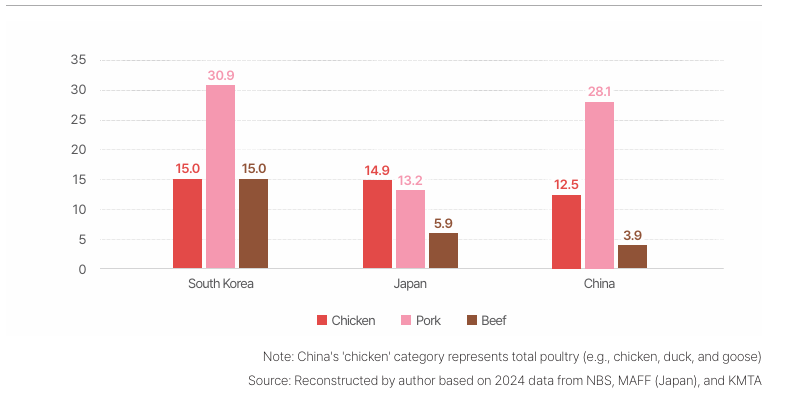
Figure 2: Comparative Analysis of Per Capita Meat Consumption: Korea, China, and Japan (2024) (Unit: kg)
The report calls on the Korean government to build a national-standard life cycle inventory (LCI) database spanning the entire livestock value chain, similar to Australia's AusLCI system, which includes the entire supply chain for livestock meat products. The author argues that producer-oriented GHG data must be transformed into information accessible to consumers at the point of purchase, enabling climate-informed choices alongside existing price and origin labeling.
"By turning complex carbon data into intuitive insights, this report upholds consumers’ right to know. It seeks to provide the concrete foundation needed for informed, rational, and climate-friendly purchasing decisions, encompassing not only the price and origin of products but also their carbon information,” said Hyungjung Shim, Food and Agriculture Researcher at SFOC.
ENDS.
Solutions for Our Climate (SFOC) is an independent nonprofit organization that works to accelerate global greenhouse gas emissions reduction and energy transition. SFOC leverages research, litigation, community organizing, and strategic communications to deliver practical climate solutions and build movements for change.
For media inquiries, please reach out to:
Antonette Tagnipez, International Communications Officer, at antonette.tagnipez@forourclimate.org
Share this insights