All the Pieces, No System: Building an Implementation Ecosystem for South Korea's Refrigerant Transition

About
This report examines how South Korea can strengthen implementation by drawing lessons from across Asia. Rather than a narrow focus on commitments, the report explores governance arrangements, implementation pathways, financing mechanisms, and local capacity-building efforts supporting refrigerant transition in other countries. Through comparative lessons, the report identifies practical considerations for building a more coordinated implementation framework for South Korea.
Download report
Executive summary
South Korea has established a growing set of policies and targets on the phase-down of hydrofluorocarbons (HFCs) for climate action. Yet these measures remain fragmented across institutions, laws, and policy frameworks, while overlapping targets are not fully aligned into a clear transition pathway. As Korea moves from establishing policy foundations toward implementation, the key challenge is not simply to strengthen its compliance with the Kigali Amendment (KA), but to build a coherent national framework that can provide clear direction for refrigerant transition and translate existing policy ambition into sustained emissions reductions. This report examines this implementation challenge through experiences across Asia and identifies practical priorities for Korea.
Key findings
A decade after the Kigali Amendment, Korea is firmly positioned within Asia's sustainable cooling transition.
A decade after the adoption of the KA, cooling demand is growing rapidly in Asia, stressing the importance of implementing phase-down commitments. Asia accounted for approximately 65% of global air conditioner demand in 2024. At the same time, South Korea remains an important manufacturing and technology hub for the cooling sector, with major Korean manufacturers operating production networks across Asia. This places Korea within a broader regional transition in which the choice of refrigerants, equipment technologies, servicing practices, and end-of-life management will increasingly shape both domestic and regional HFCs emissions.
Meeting refrigerant transition goals requires more than controlling HFCs consumption.
The continued increase in HFCs emissions across much of Asia, despite the expansion of national policies, demonstrates the gap between policy commitments and emissions outcomes. Refrigerant transition requires an implementation system that connects regulation with technical capacity, financing, industry participation, and lifecycle refrigerant management (LRM). Declining HFCs consumption does not necessarily result in declining emissions because large quantities of refrigerants remain contained in existing equipment and can be released over many years through leakage, servicing, and disposal. In Korea, the estimated quantity of refrigerants contained in existing equipment is roughly twice its reported annual HFCs emissions. This highlights why consumption controls alone cannot deliver the full climate benefits of the KA and why recovery, reclamation, reuse, and end-of-life management must be integrated into the transition.
Korea has made policy progress, but fragmented governance and unreconciled goals are limiting implementation.
Korea has ratified the KA and developed several policy measures and planned legislation to strengthen refrigerant management. However, responsibilities for refrigerant recovery, treatment, reporting, and transition remain distributed across different ministries and laws, while existing regulations cover only specific equipment categories. At the same time, Korea’s HFCs reduction targets under different policy frameworks are not yet presented within a single, coherent ambition framework. This creates uncertainty over how individual measures contribute to an overall transition pathway and makes it difficult to establish clear institutional responsibilities for delivering them. The challenge is particularly important because Korea’s recent decline in HFCs consumption has not been accompanied by declining emissions, suggesting that current progress is not yet supported by a sufficiently durable implementation system.
Upcoming legislation and regional models offer South Korea a path to durable refrigerant governance.
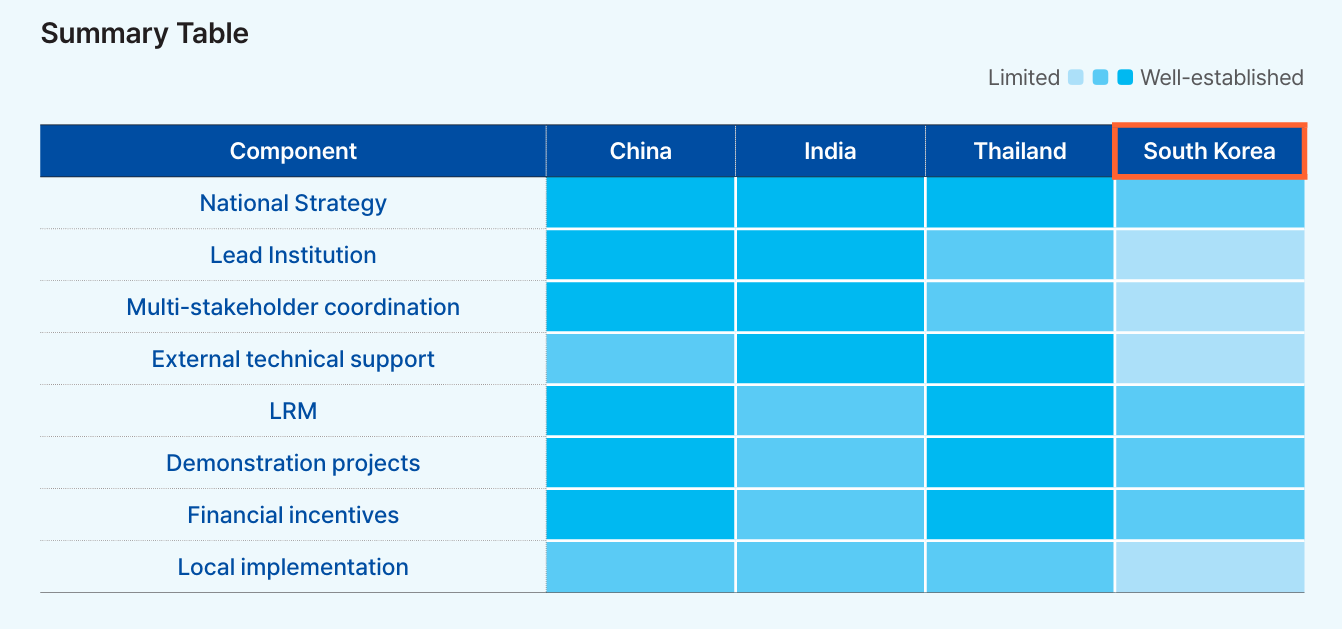
China’s binding national planning, India’s distributed multi-stakeholder responsibility, and Thailand’s reciprocal international partnerships each illustrate adaptable mechanism for closing implementation gaps. These provide concrete starting points suited to Korea’s own institutional context. Two developments already underway offer a concrete opportunity to do this: the pending Refrigerant Management Act, which would give Korea’s refrigerant measures legal force, and the upcoming 2nd National Basic Plan for Carbon Neutrality and Green Growth, through which Korea’s overlapping targets could be reconciled within a single, coherent ambition framework. Alongside these, strengthening inter-agency coordination, expanding financial and technical support for local governments to replicate and scale initiatives such as Chungnam’s and pursuing reciprocal international engagement would help convert Korea’s existing policy ambition into a durable implementation system. This is not just for Korea’s own climate objectives, but for the broader success of refrigerant transition across Asia.


