New Solutions for Our Climate research finds that leading commercial banks lent $24 billion to the world's top container lines, while nearly all of South Korea's $58 billion in public shipbuilding finance went to fossil-fuel-only vessels.
November 23, 2026 (SEOUL) – Private and public financial institutions continue to channel billions of dollars into the construction of ships that can only run on fossil fuels, risking decades of additional emissions from an industry committed to reaching net zero by around 2050. A new report by Solutions for Our Climate (SFOC) examines how financing decisions are shaping the global shipping fleet, finding that climate considerations remain largely absent.
Global ship finance totaled approximately $680 billion as of December 2025. The report, Capital at the Helm: Financing Decisions and the Future of Shipping, traces how commercial banks and public financial institutions influence which ships are built and what fuels they run on. Ships ordered today could remain in operation well into the 2040s and 2050s, meaning financing decisions made now will shape the fleet and its emissions for decades.
Although the International Maritime Organization’s (IMO) proposed Net-Zero Framework (NZF) is still pending adoption, its GHG Strategy commits international shipping to reaching net-zero greenhouse gas emissions by or around 2050. Yet an overwhelming majority of new ships are still being built with engines that can only run on fossil fuels. Vessels capable of running on zero- and near-zero-emission (ZNZ) fuels accounted for only around 5% of newbuild orders of 5,000 gross tons or above between 2023 and August 2026.
Commercial banks continue lending billions to build fossil-fuel-only ships
SFOC examined lending by the ten largest commercial bank creditors to shipping-related entities of the world's top ten containership groups, including MSC, Maersk, CMA CGM, and Hapag-Lloyd. Between 2016 and 2025, these banks provided $24 billion in loans to those entities. Approximately $12.9 billion across 140 deals was identified as likely related to vessel orders, based on the stated use of proceeds.
The groups ordered 737 new vessels between January 2020 and July 2026. Of these, 636 (86%) were only capable of fossil-fuel propulsion. With ships typically operating for 20 to 30 years, these orders risk extending fossil fuel dependence well into the middle of the century.
Eight of the ten largest creditors are headquartered in Europe: BNP Paribas, Santander, Société Générale, UniCredit, HSBC, ING, Crédit Agricole, and Standard Chartered.
South Korean public finance overwhelmingly supports fossil-fuel-only ships
The picture is similar for public finance. South Korea, alongside China and Japan, account for around 90% of global shipbuilding.
Between 2015 and 2026, South Korean export credit agencies (ECAs), KEXIM and K-SURE, along with three other public financial institutions, together provided approximately $58 billion in loans and guarantees for newbuilds constructed in Korean shipyards. Of this, $53.8 billion (93%) supported fossil-fuel-only-propelled vessels. In 2025, public financing provided $660 million for ZNZ-capable vessels and $5.3 billion to fossil-fuel-only vessels.
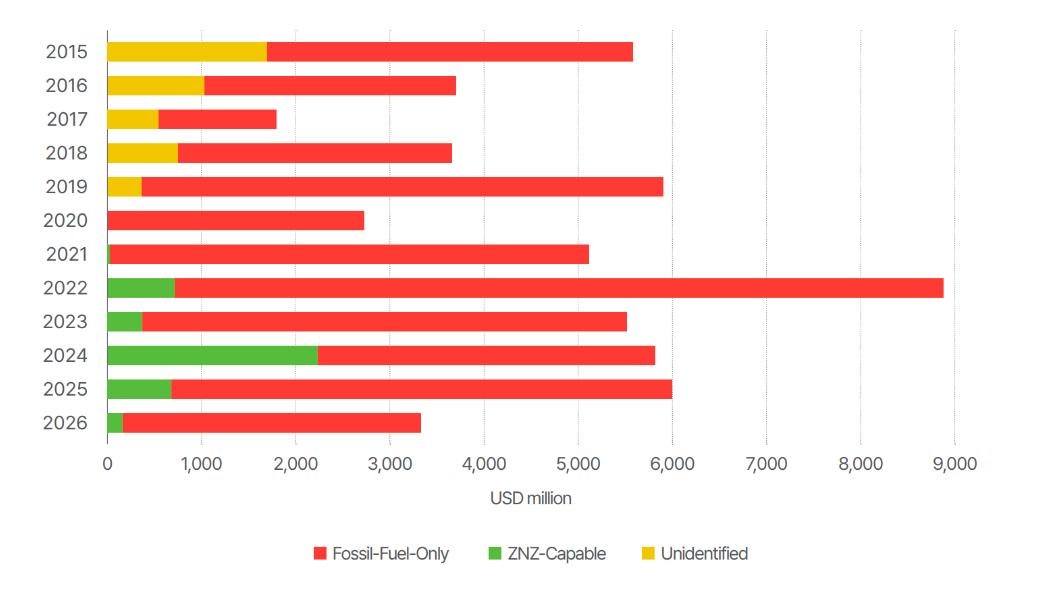
Figure: Year-over-year trends of South Korean public financing toward vessel newbuild
The country’s shipbuilding output reflects this pattern. Of the 1,593 newbuilds constructed in Korean shipyards over the period, 1,515 (95%) were equipped with engines capable of running only on fossil fuels.
But South Korea has already demonstrated its ability to compete in the construction of cleaner ships. According to Clarksons World Fleet Register, Korean shipyards built 26 of the 59 vessels capable of running on ammonia or methanol delivered globally in 2025, ranking second worldwide behind China.
The report highlights that South Korea must prioritize public financing support for building ZNZ-capable vessels to maintain its industrial advantage and market competitiveness.
Existing financing governance falls short of climate goals
A growing number of frameworks, including the EU’s Capital Requirements Regulation (CRR), ask financial institutions to assess climate-related risks in their portfolios. However, as the report finds, many primarily focus on emissions measurement and disclosure rather than preemptive restrictions. They also often overlook a ship's cumulative emissions over its full operational lifetime. Furthermore, transaction-level information is often opaque for many private financing arrangements.
For public finance, the gap is wider still. OECD rules governing ship export credits do not consider a vessel’s fuel type or emissions intensity. The export credit agencies of China, South Korea, and Japan have also not joined voluntary initiatives such as the Net-Zero Export Credit Agencies Alliance.
The report points to a precedent for stronger action: in 2021, OECD Participants agreed to end export credit support for unabated coal-fired power plants. SFOC argues that similar restrictions should be considered for new fossil-fuel-only vessels.
Valerie Xu, Shipping Policy Researcher at SFOC, said, "Financiers must move beyond retrospective disclosure of their portfolio’s climate impact and take responsibility for what they finance. Both private and public financial institutions must strengthen due diligence criteria for ship financing, with the goal of restricting financial support for vessel newbuilds that can only run on fossil fuels."
SFOC recommends that financial institutions: require robust climate due diligence for newbuild lending; set clear financing restrictions for fossil-fuel-only-propelled vessels; improve transparency through disclosure of their financing policies and transaction-level information; and redirect financing towards green and low-carbon shipping.
ENDS.
Solutions for Our Climate (SFOC) is an independent nonprofit organization that works to accelerate global greenhouse gas emissions reduction and energy transition. SFOC leverages research, litigation, community organizing, and strategic communications to deliver practical climate solutions and build movements for change.
For media inquiries, please reach out to:
Niyati Shetty, International Communications Officer
niyati.shetty@forourclimate.org
Share this insights


