EU carbon border rules, corporate emissions reporting and consumer-protection laws could undermine the value of Japan’s mass-balance approach to green steel.
November 17, 2026 (TOKYO) – A new legal analysis endorsed by SFOC and Transition Asia has identified significant risks for Japanese steel marketed as “green” under the Japan Iron and Steel Federation’s (JISF) mass-balance approach as European regulations increasingly focus on the actual emissions associated with steel production, which may expose downstream buyers to greenwashing risks.
The analysis Report on the European Union Law Vulnerabilities of the Japanese Green Steel Standard and the JISF Mass-Balance Approach, authored by Dr. Niccolò Ridi of King’s College London, Dr. Giulia Claudia Leonelli of the London School of Economics and Political Science, and SeungPyo Espée Hong, examines how Japan’s green steel certification approach interacts with the EU Carbon Border Adjustment Mechanism (CBAM), corporate reporting and consumer-protection rules.
Japan’s major steelmakers increasingly market “GX” or “green” steel using a mass-balance approach, where verified emissions reductions are allocated to selected steel products through certificates. In practice, this means the steel itself may be produced in the same way as conventional steel. The “green” benefit comes from how emissions reductions overall are counted by the producer and may not apply to the specific steel being sold.
The analysis identifies three key risks:
Carbon Border Adjustment Mechanism (CBAM): The certificates provide no reduction in CBAM liability, CBAM calculates embedded emissions based on emissions from the production process, rather than emissions reductions allocated to individual products through certificates.
Scope 3 emissions: European buyers cannot simply use these certificates to report lower emissions for the steel they purchase under the standards examined in the report.
Consumer claims: Companies using certified steel to market products such as cars as low-carbon could face risks under EU consumer protection rules.
The report does not conclude that mass-balance certification itself is unlawful. Rather, it finds that the approach is structurally misaligned with several EU rules that focus on emissions linked to the physical product and production process.
SFOC webinar examines implications for Japanese steelmakers
SFOC hosted a webinar to present the findings, with support from the Japan Climate Leaders’ Partnership (JCLP), examining what Europe’s changing regulatory environment means for Japanese steelmakers and companies using Japanese steel. The webinar was attended by over 120 people from across industry, civil society, media and the corporate sphere.
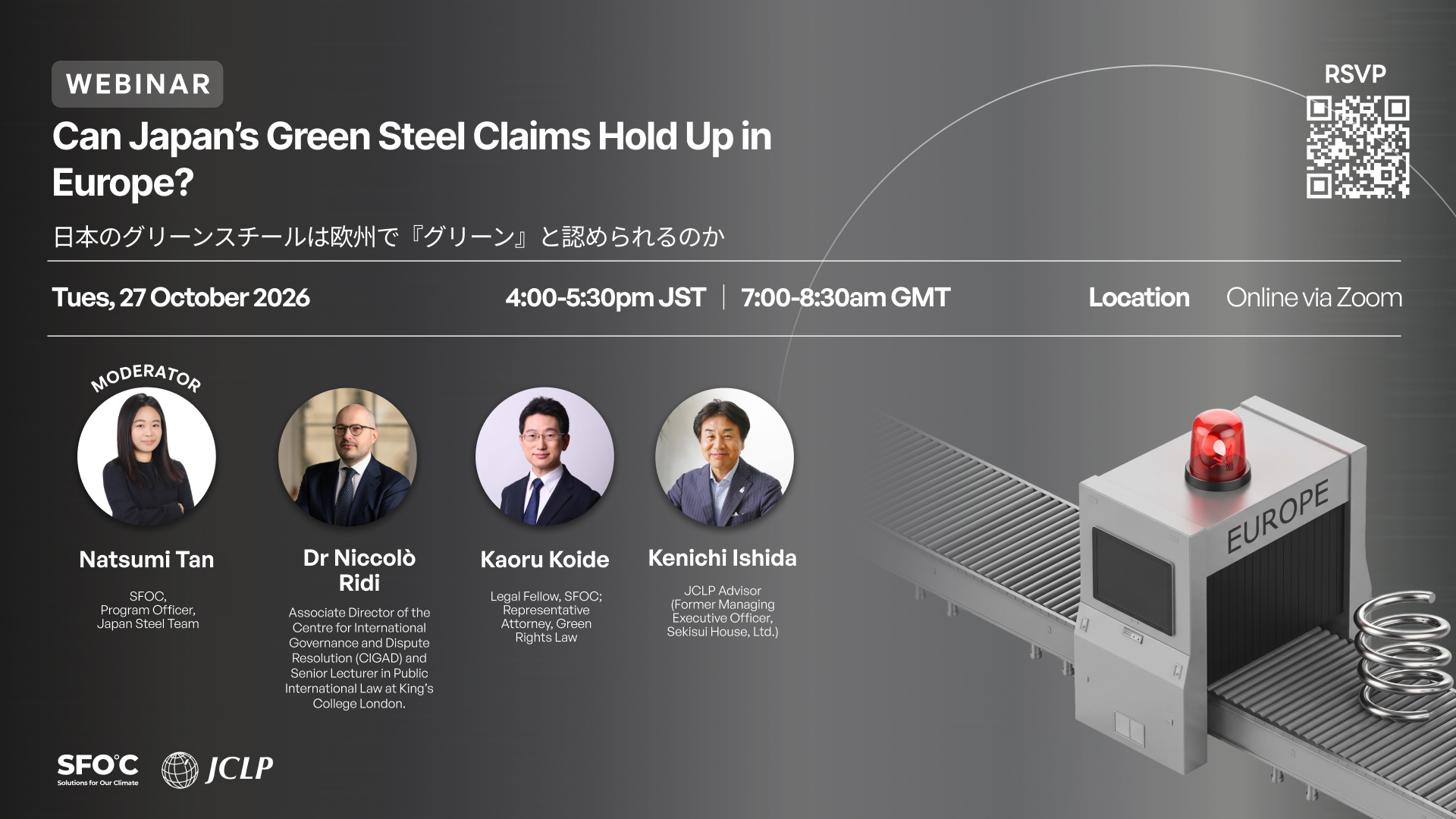
Dr. Niccolò Ridi, one of the report’s authors, delivered a keynote presentation on the legal analysis and the potential risks facing Japan’s mass-balance approach in Europe. The webinar was also covered by Japanese sustainability media outlet Alterna.
For Japanese steelmakers looking to compete in Europe, the findings point to an increasingly important distinction: a “green” label may not provide a regulatory advantage if the steel itself is not produced with lower embedded emissions.
Transition Asia, Japan Lead, Kenta Kubokawa “This report identifies potential legal risks of Japan’s GX Steel Approach. As global policies take shape, Transition Asia foresees growing risks for steel consumers on the demand side. The report helps steel buyers and steelmakers understand the practical legal risks of GX steel across both upstream and downstream products, including how GX steel and products made from it are likely to be treated under global policy schemes.”
SFOC, Legal Fellow, Kaoru Koide “EU law looks at the emissions of the steel itself, not at the certificates attached to it, so the legal risk falls first on the companies that use this steel, including Japanese manufacturers exporting to Europe. Japan’s steel industry and government now face a choice: keep reallocating reductions on paper, or base product claims, public procurement and subsidies on the actual emissions of every steel plant.”
SFOC, Steel Program Officer, Natsumi Tan “As one of the world’s major steel producers, Japan has an important role to play in shaping credible markets for low-emissions steel. Ensuring that green claims are transparent and linked to meaningful emissions reductions will be central to building confidence among buyers and policymakers. This analysis identifies misalignment between current domestic methodologies and emerging EU requirements, and we hope it can support constructive discussion on robust and internationally credible standards.”
Read the full analysis: https://forourclimate.org/research/710
ENDS.
Solutions for Our Climate (SFOC) is an independent nonprofit organization that works to accelerate global greenhouse gas emissions reduction and energy transition. SFOC leverages research, litigation, community organizing, and strategic communications to deliver practical climate solutions and build movements for change.
For media inquiries, please reach out to:
Cody Williams, International Communications Officer, Japan
cody.williams@forourclimate.org
Share this insights


