
In This Edition:
Climate multilateralism shapeshifts post-COP30, with the Asia-Pacific a key player in “coalitions of the willing” driving climate action amid a fragmented UNFCCC system
The Asia-Pacific juggles dual identity of fossil fuel giant and clean energy leader as global climate leadership vacuum looms
Pacific SIDS like Vanuatu set new precedents for legal accountability on climate, adding new teeth to calls for a full phaseout of fossil fuels
APAC emerges as a new global hub for climate action, leveraging comparative advantage in renewable energy and clean technologies to accelerate global energy transition
2025 was an eventful year for climate, complete with record-breaking extreme weather events, landmark legal decisions and continued retreat (and in some cases, complete withdrawal) of some of the biggest players in the multilateral arena. Brazil’s COP30, in failing to secure binding commitments on fossil fuel phaseout despite above average political will, for many now stands as the poster child for the failure of consensus-based climate action. Yet, between the cracks of a fragmenting UNFCCC system, things are shifting.

Parallel roadmaps, new coalitions and counter-spaces continue to emerge in defiance of a broken status quo, signaling a gradual reshaping of climate multilateralism as we know it. The Asia-Pacific, a region at the crossroads of intensifying climate vulnerability, growing energy demands and dominance of the global renewable energy market, has been at the forefront of this shift. From subnational-level renewable development initiatives in Southeast Asia to industrial decarbonization pilots across East Asia, the Asia-Pacific has become an emerging hub for real progress in spite of procedural deadlock, a potentially key pivot point in an era where climate action is more critical than ever before.
In our first edition of the ACS newsletter for the year 2026, we recap last year’s major climate developments across the Asia-Pacific, examine the region’s struggle to navigate its dual identity as an enabler of continued fossil fuel expansion and a leader in industrial decarbonization and energy transition, and unpack what these factors mean for Asia’s evolving role in global climate leadership.

Climate Multilateralism, Redefined
2025 marked the 10th anniversary of the Paris Agreement, the (then) unanimous global commitment to keeping global temperature rise below 1.5°C which has since served as the backbone of modern climate multilateralism. More than a decade later, despite notable progress, especially on renewable energy expansion, the world remains off track, navigating pressure to meet climate targets while juggling competing issues of energy security, geopolitical instability, growing power demand and increased supply chain disruptions.
With a 1.5°C overshoot almost guaranteed within the next ten years, countries need to cut emissions by at least 35% by the year 2035 to limit warming to under 2°C. Yet even this goal remains out of reach, with weak and delayed Nationally Determined Contributions (NDCs) projected to only limit warming to between 2.3-2.5°C even if fully implemented. At COP30 in Brazil last November, momentum building towards a binding agreement to phase out fossil fuels was ultimately stifled by a lack of formal consensus, despite clear proof of political will. The Global Mutirão’s ambitious calls for a bottom-up, cross-cutting approach to realigning with the Paris Agreement were only partially met with hard-fought wins on tripling adaptation finance and solidifying progress indicators, further exposing the fragile nature of the UNFCCC’s consensus-based system.
Yet, in the wake of COP30, climate multilateralism has begun to take on a new shape, one where progress is taking place outside of plenary rooms and commitments are being spearheaded by informal coalitions pushing for action both in tandem with and independent of the UNFCCC system. What has emerged is what COP30 President André Corrêa do Lago describes as a “two-tier” approach to climate action, one which “no longer depends on formal authorization, nor is it confined to a single country, actor, or sector.” In its most recent iteration, climate multilateralism now pursues a delicate balance between universal legitimacy and enforceability afforded through consensus-based frameworks and accelerated implementation spearheaded by independent “coalitions of the willing”.
As traditional climate juggernauts turn inwards, new protagonists, including small island developing states (SIDS) like Vanuatu, “middle powers” like Colombia and transnational, often Indigenous-led civil society coalitions, are uprooting rigid ideals of who and what controls progress on climate action, directly challenging the status quo of global climate leadership. The Asia-Pacific has been no exception. Between its share of global emissions, dominance of the clean energy market and invaluable role as the backbone of global trade and industry, what happens in the APAC region will largely determine the success of an evolved multilateral climate framework – and whether global climate goals will remain within reach.

2025’s Climate Highlights
2025 clocked in as the third warmest year on record, following a worrisome trend of accelerating sea level rise, glacial melt and extreme heat. The year was characterized by a series of catastrophic weather events, including massive heatwaves and wildfire outbreaks, record-breaking hurricanes, severe flooding and unexpected droughts. Rising levels of ocean acidification saw seven of nine critical planetary boundaries officially breached, pushing the planet closer to its first major tipping point.
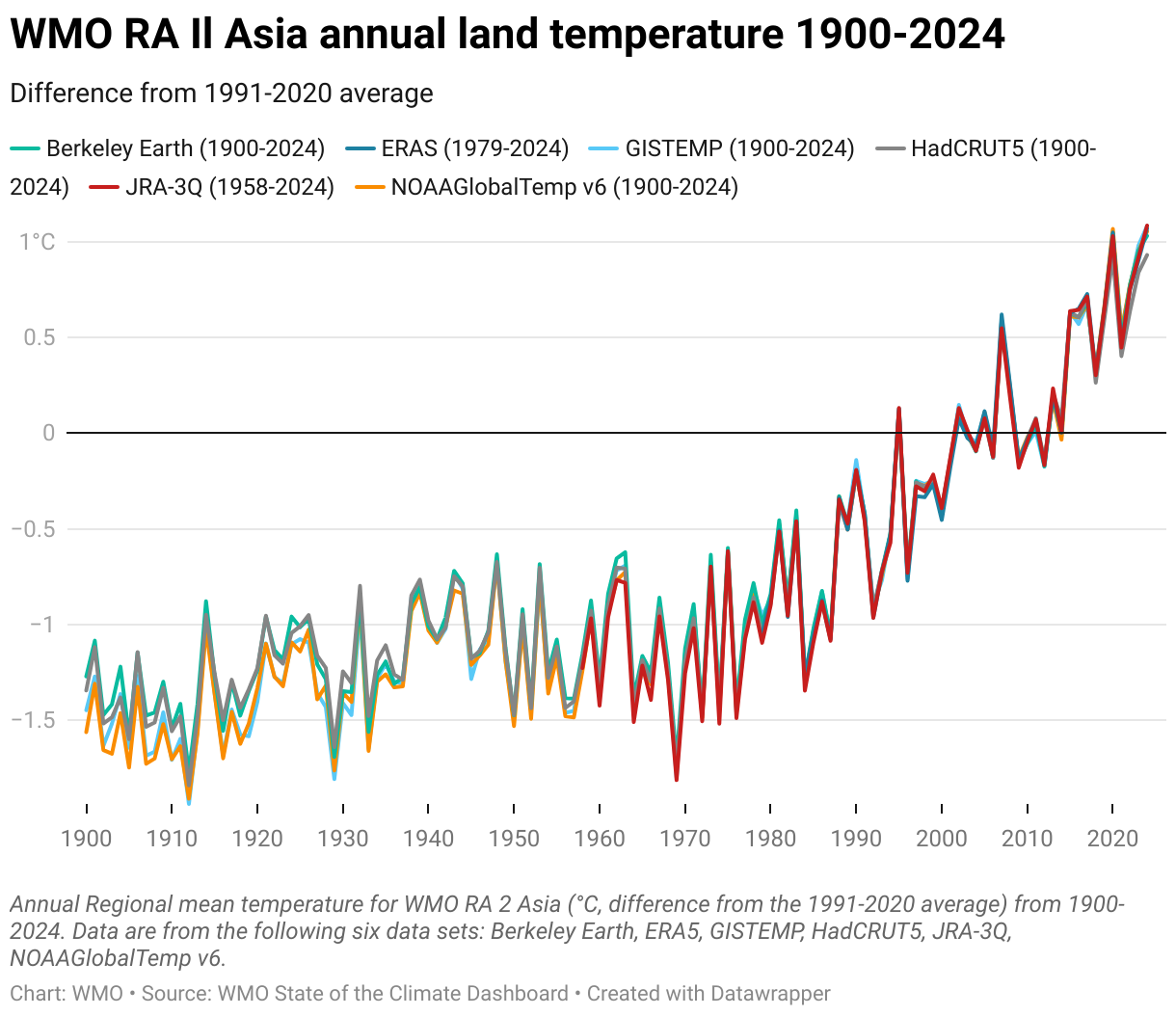
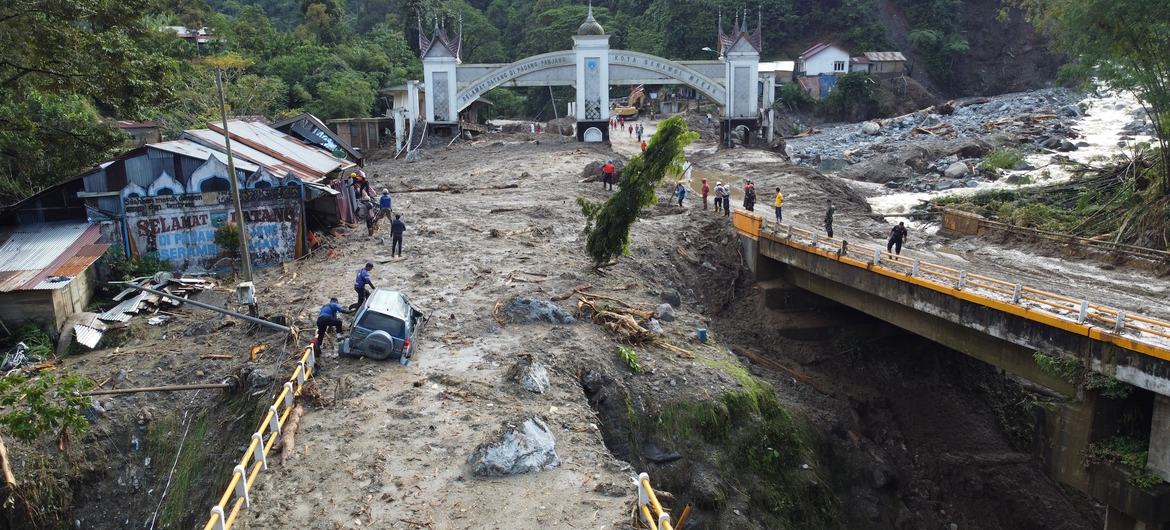
APAC, a region warming at twice the rate of the rest of the world, was inundated – literally and figuratively – with a series of extreme weather events that left thousands dead, millions displaced and billions of dollars in damages, accounting for four of the six most expensive climate disasters recorded in 2025. Extreme heat in South Korea, Japan and Vietnam, floods and drought across China and deadly floods and landslides across Southeast Asia last November brought fresh attention to the role of continued fossil fuel expansion in worsening the impacts of anthropogenic climate change, often at the expense of the most vulnerable. Yet the state of progress across APAC – a precarious dichotomy of widespread renewables scaleup and continued investment in coal and natural gas – reflects a continued struggle to transition away from fossil fuels while guaranteeing economic viability, access to affordable, reliable energy, and increased resilience to climate and geopolitical shocks with the potential to cripple traditional energy supply chains.
At the same time, 2025 saw countries step further into what energy think tank Ember dubs the “electrotech” era: the combined expansion of renewable energy and clean technology, battery-based storage and the widespread electrification of transport, heating and industry. In an unprecedented first, wind and solar energy surpassed coal as the world’s leading source of electricity, making up just over a third of global electricity produced in 2025. Recent figures now indicate global RE capacity has officially outpaced global electricity demand growth, solidifying solar and wind energy investment as a key enabler in accelerating the energy transition.
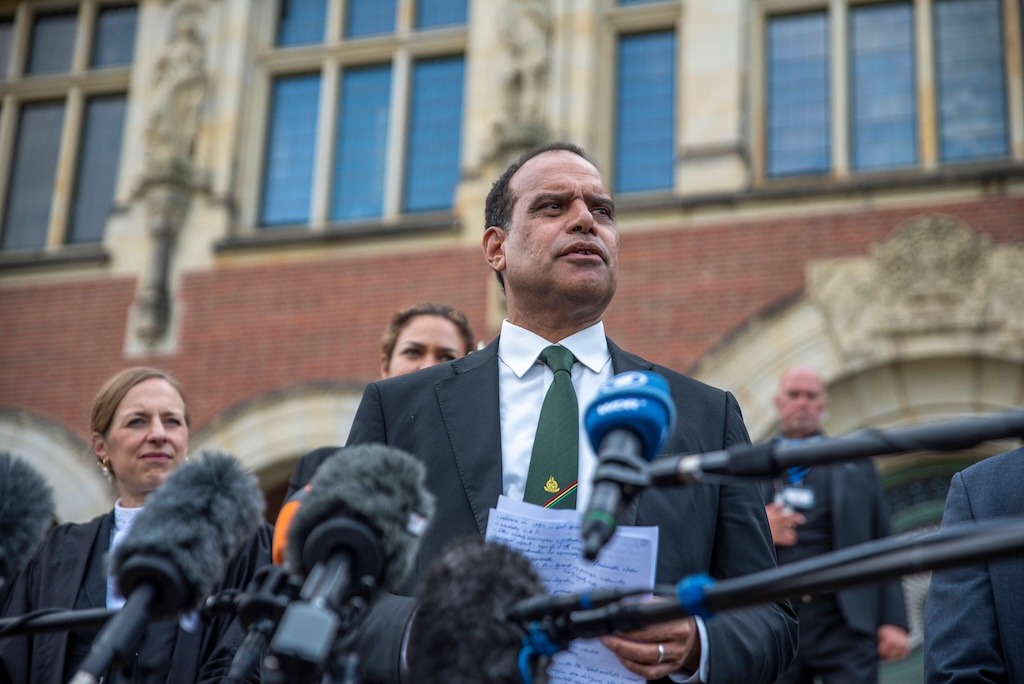
2025 also saw the emergence of a stronger focus on climate justice and legal accountability. Last July, a student-led request to the International Court of Justice (ICJ) from the Pacific island state of Vanuatu led to the court’s landmark Advisory Opinion on Climate Change, which clarifies states’ obligations under international law to reduce emissions and address the impacts of the climate crisis. The Opinion, now set to potentially inform a legally binding UN Resolution, opens new doors for climate litigation, sending a strong warning to governments and state-owned enterprises (SOEs) perpetrating climate harm.
Along a similar vein, the High Seas Treaty was officially ratified after more than two decades of debate last September, legally binding its signatories to safeguard marine biodiversity and ecosystems beyond areas of national jurisdiction.
The year wound down with COP30, which, though failing to secure a binding commitment on fossil fuel phaseout, gave rise to counter-spaces like the upcoming Colombia-hosted inaugural International Conference on the Transition Away From Fossil Fuels (TAFF) and parallel roadmaps on deforestation set to be implemented through initiatives like the Tropical Forests Forever Facility (TFFF). Civil society presence on the ground in Belém hit new highs, doubling down on demands for greater representation and inclusion of Indigenous peoples and local communities (IPLCs) in the UNFCCC decision-making process. At its core, Brazil’s comprehensive, multisectoral COP30 Action Agenda reflected the growing pressure to do implementation differently, drawing special attention to cross-cutting issues of access to financing, enabling technologies and capacity building as means of accelerating climate action both within and across countries.

Reframing the Global Energy Transition
Beyond the optics and a handful of concrete commitments, 2025 still revealed an uncomfortable truth about the reality of addressing climate change and its impacts in the current global environment: framing climate action as a moral debt owed to the planet and the most vulnerable has long lost its efficacy. As we continue into 2026, energy security, industrial competitiveness and economic growth will be the factors shaping countries’ decision-making when it comes to widespread energy transition, let alone a full fossil fuel phaseout. This is especially true for emerging economies, where rapid urbanization and rising development levels continue to increase demand for cheap, reliable energy.
At present, a transition away from fossil fuels is being positioned as a core strategy for achieving economic growth and ensuring energy independence amid growing geopolitical uncertainty. In turn, countries which step up first stand to gain significantly as their peers follow suit, potentially ushering in a new paradigm where investing in the global energy transition is a win-win for all involved. In a shapeshifting multilateral arena where traditional agenda setters are turning inwards, the Asia-Pacific region stands primed to take on this role and help close the existing vacuum in global climate leadership.
The Case for Asia-Pacific Climate Leadership
There is a strong case to be made for Asia-Pacific leadership on climate and energy transition issues. The region is essentially the backbone of trade and industry, spearheading global manufacturing and playing a critical role in sustaining global value chains, including the LNG trade. It boasts a GDP more than three times that of Europe, accounting for 70% of global GDP growth in the decade leading up to 2025, and is home to the world’s two most populous countries, China and India, which alone make up 36% of the global population.
Last year, APAC accounted for almost half of global GHG emissions and was responsible for more than 80% of global coal-based power generation. On the current trajectory, the region is set to miss 103 out of 117 SDG targets by 2030, most due to a lack of action on climate. Pressure to decarbonize while meeting energy needs is being met with increased investment in liquefied natural gas (LNG) and biomass co-firing, two widely touted “solutions” with largely overlooked environmental consequences, alongside a continued coal addiction.
At the same time, APAC’s track record on climate isn’t all doom and gloom. Recent findings revealed the region saw the second-largest jump in global renewable energy growth in 2025, and remains the only region on track to achieve the COP28 goal of tripling renewables capacity by 2030. China and India, the world’s largest emitters, saw the first simultaneous fall in power sector emissions in over half a century – enough to offset coal power generation growth elsewhere. Last November, South Korea, alongside Bahrain, officially joined the Powering Past Coal Alliance (PPCA), publicly committing to retiring two-all coal power plants by the year 2040. Although the move solidifies existing government pledges to retire 40 of its 61 plants, the roadmap for early retirement of the remaining 21 remains unclear. Meanwhile, Cambodia became the 18th country to endorse the Fossil Fuel Treaty Initiative.

These contradicting truths reveal the longstanding tension facing a region where climate action is by no means one-size-fits-all. Across the Asia-Pacific, progress and regression coexist as ambitious policies designed to transition deeply entrenched fossil fuel-based energy systems compete against rising demand for reliable, affordable electricity, barriers to renewables expansion and energy security concerns. Countries wear several hats, sometimes at all once, appearing as champions of industrial decarbonization, defenders of policy flexibility and development space, but in many cases, enablers of continued fossil fuel expansion. Climate action equals mitigating an existential threat for some, securing influence and market dominance for others, and complicating or delaying much needed development for others still.
In any case, with global power demand set to rise rapidly throughout 2026 largely due to AI and data center expansion, geopolitical tensions, supply chain uncertainty and climate impacts, APAC stands at a critical juncture. As typhoons intensify, conflicts cut off access to traditional energy sources and islands slowly sink into the ocean, the region must now find a way to decarbonize while securing the livelihoods of its people and taking responsibility for its greater role in perpetuating the global climate crisis – a task that, while daunting, the world clearly believes the Asia-Pacific is ready to take on.
APAC and the Spillover Effect
Asia’s involvement – and often dominance – in essentially every facet of global trade and industry means whatever happens in the Asia-Pacific will inevitably have ripple effects far beyond the region itself. This also applies to climate action, even more so in an era where the emerging dangers of fossil fuel reliance are spurring momentum towards greater investment in clean energy technologies and RE expansion.
As geopolitical shocks like widespread tariff rollouts and unfolding conflicts in key oil and gas producing regions reshape the energy security conversation, climate and energy diplomacy will rise anew as those under pressure to meet growing power demand seek to establish and strengthen partnerships capable of shielding them from the worst of the fallout.
Countries with a basically unrivalled comparative advantage in producing these technologies – like China and India - stand to exert significant influence over the global energy market, facilitating mass exports and eventual adoption in energy import-dependent countries in and outside of APAC. There is much to be gained from investing in and piloting projects related to green steel and low-to-zero carbon marine fuels, for example, which could cement the Asia-Pacific as a leader in transforming hard-to-abate industries like maritime shipping and steel production. Strong policies, deepened regional cooperation, legal frameworks and multilevel, multisectoral engagement will be key in making the most of this potential.
For those most vulnerable to the impacts of climate change, energy security goes hand in hand with survival. Mobilizing the finance required to effectively adapt to and rebuild in the aftermath of intensifying climate disasters has long been a collective effort spearheaded by a global coalition of Small Island Developing States (SIDS) from the Caribbean, the Pacific and the Atlantic, Indian Ocean, Mediterranean and South China Sea (AIMS). With adaptation finance commitments standing at ~12-14 times less than the US$365 billion needed by 2035, diplomatic strategy has shifted from one of appeals to ethics and emotions to one of justice and legal responsibility, as seen in the Vanuatu-inspired ICJ Advisory Opinion. This shift has not been limited to just SIDS.
Last July, South Korean farmers took the state-owned electric utility KEPCO to court over billions in climate-related losses due to its corporate emissions. Late December saw a similar case brought against the Japanese government, with plaintiffs criticizing its “grossly inadequate” response to the climate crisis. The Indonesian government is currently suing six companies linked to deforestation which worsened devastating floods and landslides which hit the country last November. As climate change continues to wreak havoc across the globe, more of these cases will likely emerge – and the ICJ’s next moves will determine the extent to which a legally binding commitment to climate action will be effective in ushering in a just energy transition.
APAC: The Climate Pivot Point
The Asia-Pacific’s capacity to lead and create momentum for a global energy transition, while underestimated, has not gone unnoticed. The potential for leadership is increasingly emerging beyond national pledges, through regional alliances, subnational action, and community-driven climate initiatives that move faster than traditional multilateral processes. These diverse diplomatic and governance pathways position Asia not just as a participant in global climate politics, but as a norm-setter and testing ground for the next phase of climate leadership.
This potential has been reflected in the recent concentration of climate issue-raising, policymaking and implementation-oriented spaces – both in and out of the UNFCCC circuit - popping up across the region. The Asia-Pacific is quickly emerging as a trusted hub in which climate progress – whether that is renewable and clean energy tech expansion, just transition, adaptation financing or civil society/Indigenous representation – takes center stage. From longstanding forums like the Clean Energy Ministerial and Asia-Pacific Economic Cooperation (APEC) meetings to emerging homegrown initiatives including climate weeks in Bangkok, Mumbai and Hong Kong to global negotiations sessions like INC 5.1, the region is quickly evolving into a new arena where the future of climate action will be contested and shaped.
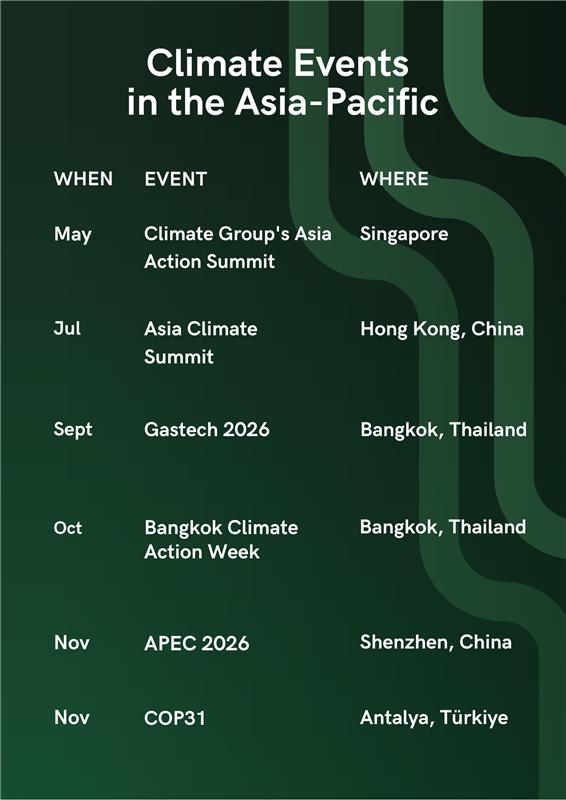
This pattern is set to continue into 2026, with South Korea set to host the first of two UNFCCC Climate Weeks in the southern port city of Yeosu in late April, running alongside the inaugural Korea Green Transformation (K-GX) International Week, showcasing the latest in decarbonization and carbon neutrality initiatives. The latter half of the year will see major energy and climate conversations converge at COP31 in Antalya, Türkiye, with Australia set to lead official negotiations. Pacific SIDS, in partnership with Australia, will now host preliminary events this October, with Fiji hosting the official Pre-COP and a special leaders’ meeting slated for Tuvalu, alongside a separate event in Palau this August. Their representatives hope these meetings will draw special attention to the real-time impacts of climate change, potentially spurring stronger climate action commitments.
Stepping Up to the Plate
From the outset, 2026 is shaping up to be a pivotal year for climate action, especially against a backdrop of growing nationalism, new and continued geopolitical conflicts, and the worsening impacts of climate change. Decisions made across the Asia-Pacific region, with all of its differing priorities and constraints, have the potential to materially influence the global trajectory towards a just energy transition, increased adaptation financing and improved climate governance.
Armed with comparative advantage in renewable energy expansion capacity and more than half of global trade and industry reliant on its energy choices, the Asia-Pacific must now weigh its options carefully. The path it chooses to carve out will become a blueprint that reverberates across regions, shaping the policies, commitments and political will that will determine the future of the world’s energy systems, and ultimately, our ability to respond to the climate crisis. Put simply, the “right” choice will no longer be just a regional strategy, but a global imperative.


